

Key breakthrough in the mistery of SDSO-1: new analysis shows that the giant oxygen nebula discovered near Andromeda lies in our own galaxy
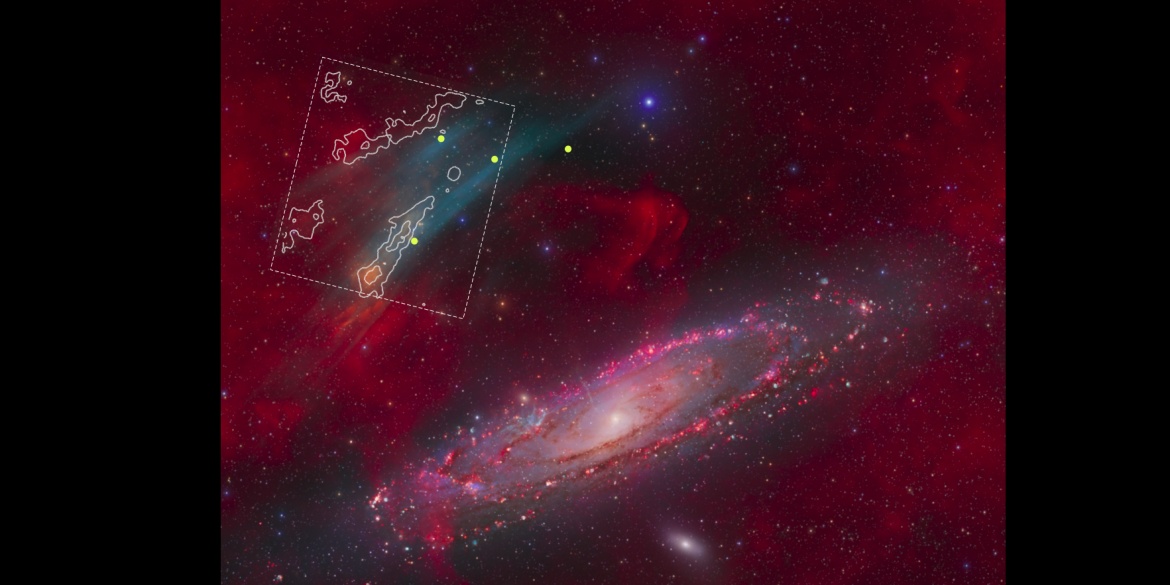
Composite image combining the original deep-exposure picture obtained by Strottner, Drechsler, and Sainty, complemented by Alejandro Lumbreras Calle and CEFCA. The SDSO-1 nebula appears as turquoise-colored arcs, and the white box marks the area observed from the OAJ (with white contours indicating oxygen emission). The yellow points indicate the regions observed with the MEGARA instrument on the GTC. Source: CEFCA // A. Lumbreras, Strottner, Drechsler, Sainty. 2025.
In January 2023, a group of amateur astronomers surprised the community with a new long-exposure image of Andromeda. More than 130 years after the first photograph of the nearest spiral galaxy to Earth, this time something never seen before appeared beside it: a huge, faint blue arc of oxygen emission, almost as large as Andromeda itself. It was named SDSO-1, and now a study led by a team at the Centro de Estudios de Física del Cosmos de Aragón (CEFCA) has resolved the mystery of its origin.
“The first question was clear: was it a giant nebula truly close to Andromeda, or a smaller one within the Milky Way? Its apparent position next to our neighbouring galaxy could simply be a coincidence,” explains Alejandro Lumbreras Calle, leader of the team of astrophysicists who carried out this research. “It was the oxygen nebula that covered the largest area in the sky, more than three full moons. It did not fit easily into any known category, since the amateur image only showed highly ionised oxygen, and nothing else.”
To understand it better, new observations of SDSO-1 were needed. The JAST80 telescope at the Javalambre Observatory uses specialised filters different from those used in the original photograph, and it is the only telescope in Europe capable of imaging the entire nebula without the need for a mosaic. With it, the researchers identified regions where the oxygen was less energised, forming a structure with separated layers. In nebulae within our own galaxy, this separation is clearly visible, but it is too small to be distinguished in more distant objects.
Another key piece of evidence came from the MEGARA instrument on the Gran Telescopio Canarias, the largest optical telescope in the world. With these observations, the team was able to measure how the gas in this faint cloud is moving: it is approaching us very slowly, at about 10 to 30 kilometres per second. These are typical velocities for many gas clouds within the Milky Way. If the nebula belonged to the Andromeda Galaxy, however, it would be moving much faster, approaching us at roughly 300 kilometres per second. They also found a third clue: the chemical composition they measured is also very similar to that of other Milky Way nebulae.
Taken together, these pieces of evidence confirm that the nebula does not belong to Andromeda but is instead much closer to us, and it is in fact part of our own galaxy. The study also rules out the possibility that the nebula was created by a stellar explosion, another proposed scenario, as the expected gas motions for such an event are not observed. The source making the nebula shine still remains unidentified. “It may be related to ultraviolet light leaking from gas clouds around massive stars,” suggests Lumbreras-Calle. “But to fully resolve the mystery, further research will be required.”How Do Astrophysicists Study an Interstellar Nebula?
When gas nebulae receive energy (for example, ultraviolet light), they can absorb part of it and produce a fluorescence effect. As a result, they emit light at very characteristic colours, allowing astronomers to distinguish different chemical elements. These are known as “emission lines.” This phenomenon is similar to the process that produces the northern lights. Using narrow-band filters that let through only specific colours, astronomers can isolate and study different types of gas. Narrow-band imaging is, for instance, fundamental to the J-PLUS and J-PAS surveys, the main scientific goals of the Javalambre Astrophysical Observatory. In addition, at CEFCA the necessary software has been developed to study images of objects as extremely faint as this nebula.
With an instrument called a spectrograph, such as MEGARA at the GTC, emission lines can be analysed in much greater detail. For example, astronomers can determine the velocity of a nebula through the Doppler effect observed in these lines—the same effect that causes the pitch of an ambulance siren to sound higher as it approaches and lower as it moves away. In the same way, the emission lines from a nebula appear redder as it moves away from us, and bluer as it moves closer.