Understanding the Universe through Large Scale Astronomical Surveys
Description
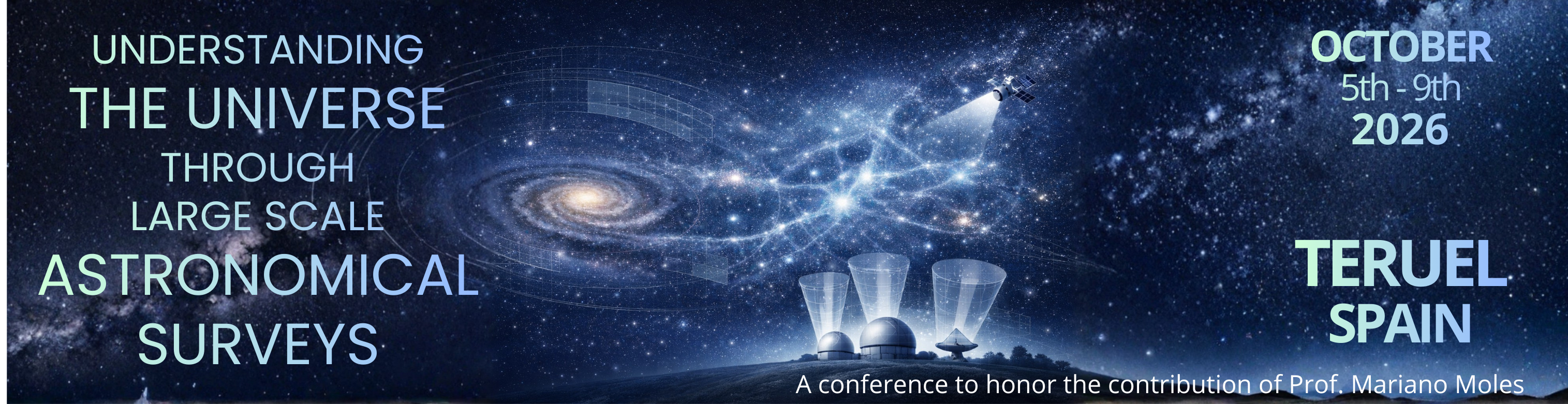
This conference aims to bring together researchers working across the full spectrum of modern astronomical survey science. Its central goal is to explore how the most ambitious current and future surveys are reshaping key areas of astrophysics, and how synergies among these projects can build on their individual goals. It will be an ideal event to celebrate the significant personal and scientific contribution that Prof. Mariano Moles has made to this topic.
Rationale
Over the past decades, wide-field astronomical surveys have transformed our understanding of the Universe. By mapping the sky with unprecedented depth, precision, and temporal coverage, these surveys have shifted astronomy from an object-by-object discipline to a data-driven science capable of addressing fundamental questions about the origin, structure, and evolution of the cosmos. Today, surveys such as Euclid, Gaia, J-PAS/J-PLUS, DESI, SDSS, the VISTA/VST surveys, and the upcoming LSST at the Vera C. Rubin Observatory (among others) are producing -or will produce- massive datasets that probe a wide range of topics in Astrophysics, from the internal dynamics of the Milky Way to the nature of dark matter and energy on cosmological scales.
This conference, “Understanding the Universe through Large Scale Astronomical Surveys,” aims to bring together researchers working in the scientific exploitation or preparation of present and future surveys to debate how these challenging projects are reshaping key areas of astrophysics, and how synergies among them can benefit our knowledge and understanding of the Universe.
Among the core scientific themes are the Main Topics described below.
- Cosmology: Characterisation of the large scale distribution of galaxies and the growth of structure over cosmic time. The study of the spatial modulation of the galaxy distribution, their peculiar velocities as triggered by Gravity, gravitational lensing and the most massive bound objects (galaxy clusters) as tools to unveil the nature of the most fundamental constituents of the Universe.
- Galaxy Evolution: Wide-field surveys are transforming our understanding of how galaxies form, grow, and quench across cosmic time. By combining deep imaging and large spectroscopic samples, these surveys reveal how internal processes—such as star formation and AGN feedback—interact with external drivers like mergers, environment, and the cosmic web. Together, they provide an unprecedented view of how nature and nurture shape galaxy populations throughout the Universe.
- Mapping the Milky Way: Precise astrometry, photometry, and spectroscopy are enabling us to reconstruct the Galaxy’s assembly history, its stellar populations, and its gravitational potential.
A crucial theme of this meeting is synergy. No single survey can capture all aspects of the Universe; each brings its own strengths in depth, area, wavelength coverage, spatial and temporal resolution, or astrometric precision. By integrating datasets across missions and facilities—space-based and ground-based, present and future—we can greatly enhance scientific return. Cross-calibration between surveys can improve photometric accuracy; combining astrometry with deep imaging can link local structures to their cosmological context; and joint analyses can reduce systematics that limit cosmological measurements.
Furthermore, the emerging era of petabyte-scale data requires new methodologies in statistics, machine learning, and data-driven discovery. This conference will provide a platform to discuss these developments and to foster collaborations that exploit the full potential of the survey landscape.
In addition, this conference carries a special significance: we will recognize the contribution in this topic of Prof. Mariano Moles, whose vision and leadership were instrumental in the creation of the Centro de Estudios de Física del Cosmos de Aragón (CEFCA) and the Observatorio Astrofísico de Javalambre (OAJ), a unique and dedicated facility located in Teruel for conducting wide-field astronomical surveys like J-PAS and J-PLUS.
In summary, Understanding the Universe through Large Astronomical Surveys seeks to highlight the transformative role of large datasets in modern astrophysics and to promote the collaborative, multi-survey approaches that are essential to addressing the most profound questions about our Universe. Through open discussion and shared expertise, this meeting aims to build a coherent vision for the next decade of survey science.
Invited speakers
The preliminary list of invited speakers includes:
- Alessia Moretti (INAF-OAPd, Padova)
- Antonella Vallenari (INAF-OAPd, Padova)
- Anna Porredon (CIEMAT, Madrid)
- Carlos Allende-Prieto (IAC, Tenerife)
- Jonás Chaves-Montero (IFAE, Barcelona)
- Lourdes Verdes Montenegro (IAA-CSIC, Granada)
- Magda Arnaboldi (ESO, Garching)
- Mara Salvato (MPE; Garching)
- Olivier Doré (JPL/Caltech; Pasadena)
- Rita Tojeiro (Univ. St. Andrews)
- Scott Trager (Univ. Groningen)
- Tesla Jeltema (UCSC, Santa Cruz)
Scientific Organizing Committee
- Alberto Fernández-Soto (IFCA-CSIC, Santander)
- Alfonso López-Aguerri (IAC, Tenerife)
- Bianca Poggianti (INAF-OAPd, Padova)
- Carlos Hernández-Monteagudo (IAC, Tenerife)
- Carlos López-SanJuan (CEFCA, Teruel)
- Isabel Márquez (IAA-CSIC, Granada)
- Javier Cenarro (CEFCA, Teruel)
- Raul Angulo (DIPC, Donostia)
- Silvia Bonoli (DIPC, Donostia)
- Vanessa Hill (OCA, Nice)
- Vicent Martínez (UV, Valencia)
Local Organizing Committee
- Ana López (CEFCA)
- Antonio Hernán-Caballero (CEFCA)
- Inés Muñoz (CEFCA)
- Javier Cenarro (CEFCA)
- Javier Lizaga (CEFCA)
- Luisa Valdivielso (CEFCA; Chair)
- Sayali Kulkarni (CEFCA)
- Stefano Zarattini (CEFCA)
- Stylianos Pyrzas (CEFCA)
- Tamara Civera (CEFCA)
Important Dates
- Mar 2nd, 2026 - First Announcement: Pre-Registration & Abstract Submission Openings
- May 15th, 2026 - Deadline for Pre-Registration & Abstract Submission
- Jul 15th, 2026 - Program Announcement & Registration Opening
- Sep 20th, 2026 - Deadline for Registration & Payment
- Oct 5th-9th, 2026 - Conference
Code of Conduct
We aim to provide a harassment-free conference for everyone, regardless of gender, gender identity and expression, age, sexual orientation, disability, physical appearance, body size, race, ethnicity, religion (or lack thereof), or technological choices. Harassment of participants, in any form, will not be tolerated during the conference. Deliberate intimidation, stalking, or sexual language and imagery is not appropriate for any conference venue, hotel or social event, including talks or online media.
If a conference participant engages in harassing or any of the aforementioned behaviors, the conference organizers may take any action they deem appropriate, including warning the offender, or expulsion of the offender from the conference with no refund.
In case of an attendee wishes to report a violation of these guidelines, or wants to express any doubt or potential concern on this matter, he/she can confidently:
- Send an email to surveys2026_at_cefca_dot_es, or
- Contact personally any member of the LOC/SOC.
LOC/SOC member badges will be a different color from those of other participants to facilitate identification if necessary
About Teruel
Teruel is located in central Spain, in the south of the Aragón region. The province is home to notable examples of Mudéjar architecture. The city of Teruel is a prime example of this architecture and was awarded the World Heritage Designation by the UNESCO. Other interesting destinations in the province are Albarracín, with its Arab fortress; Mora de Rubielos, which has one of the best conserved castles in Aragón; and Alcalá de la Selva, which is very popular for hikers due to its attractive landscapes. Truffle and local pork products (particularly the cured ham from Teruel) are highly recommended.
Tourist information about Teruel can be found on the Siente Teruel website.
Participants
| Name | Affiliation |
|---|
Pre-registration & Abstract submission
CLOSED
Registration
CLOSED Deadline: Sep 20th, 2026 - 23:59 CEST
Registration fee to attend the 5-days conference is €400, including:
1) Lunch & Coffee breaks during the five days of the conference; 2) Welcoming cocktail on Sunday, October 4th; 3) Transportation & Visit to the Javalambre Observatory and Galáctica
Additionally, attendees who are unable to stay in Teruel for the entire conference may opt for a reduced registration fee of €200, valid for attendance on two consecutive days of the event.
Participants list
The Participants list is available here.
Social Events
Sunday, 4 October at 19:30: Welcome cocktail
The Welcome Cocktail will take place at Jardín del Mausoleo de los Amantes de Teruel (Calle Caracol, 2).
Please complete the form indicated below (section "Welcome Cocktail, Conference Dinner & Dietary Requirements - Form") by October 1st at 23:59 CEST to indicate whether you plan to attend or not.
In the event of adverse weather conditions, the Welcome Cocktail will be held at the CEFCA headquarters (Plaza San Juan, 1) instead. Should this change be necessary, participants will be notified by email that same afternoon.
Monday, 5 October at 19:00 PM: Guided walking tour of the city of Teruel (english)
Discover Teruel with a guided tour of its historic center led by a local guide. As you walk through its iconic streets and squares, you will uncover its rich history, legends, Medieval heritage, and Modernist architecture. Highlights include the city's stunning Mudéjar Art, a UNESCO World Heritage site, and the famous legend of the Lovers of Teruel, Isabel and Diego.
The guided visit will be conducted in English and is offered as a courtesy of the Teruel City Council. The meeting point is outside the main entrance of Teruel City Hall (Plaza de la Catedral, 1) and it will last approximately one hour.
Please note that a registration form must be completed for each meeting participant before October 1st at 23:59 CEST here.
Tuesday, 6 October at 19:00 PM: Public Talk (spanish)
Public talk titled "La geometría del pecado: Una lectura científica y matemática de una iluminación medieval", given by Professor Emilio J. Alfaro (Instituto de Astrofísica de Andalucía, CSIC). The event is free and open to meeting participants and the general public. It will be conducted in Spanish at the Centro Cultural de San Julián (Ctra. San Julián, 14) until full capacity is reached.
Summary: This talk provides an interdisciplinary analysis of a 13th-century medieval illustration—specifically the frontispiece of a Bible—to identify mathematical patterns and fractal geometry within the depiction of chaos under the divine compass. The presentation connects Gothic art and Dante's Divine Comedy with modern cosmology and our current scientific understanding of the observable universe.
Wednesday, 7 October afternoon: Visit to Galáctica and OAJ
On Wednesday afternoon, after lunch, meeting participants will have the opportunity to visit Galáctica and the Observatorio Astrofísico de Javalambre.
Buses will depart at 8:30 AM from Paseo del Óvalo 3–7, Teruel. Participants are kindly requested to be at the departure point in advance.
Thursday, 8 October at 20:00 PM: Conference Dinner
The Conference Dinner will take place at the Hotel Palacio La Marquesa (Plaza Fray Anselmo Polanco, 2).
Please note that dinner registration and menu selection are two separate steps:
- 1.- Register and pay for the Conference Dinner through the “Dinner Registration” section of the official registration website: https://cefcameeting.com
- 2.- Select your meal option by completing the meal selection form available in the "Welcome Cocktail, Conference Dinner & Dietary Requirements - Form" section below. Full information about the available menu options is provided in the form. Please complete the form by October 1st at 23:59 CEST.
Welcome Cocktail, Conference Dinner & Dietary Requirements - Form
IMPORTANT: Please complete this form by October 1st at 23:59 CEST, whether or not you plan to attend the Welcome Cocktail and/or Conference Dinner.
The form must be completed separately for each conference participant and accompanying guest. Please indicate your attendance for each event and provide details of any food allergies, intolerances, dietary restrictions, or special dietary requirements. This information will be used to accommodate your dietary needs when organizing the meals and catering provided throughout the conference, including the Welcome Cocktail and Conference Dinner.
For the Conference Dinner, please note that completing this form is necessary to indicate your menu choice and dietary requirements, but it does not replace the dinner registration and payment through the official conference registration website.
Venue
The meeting will mainly take place at the 'Gobierno de Aragon' Local Government office building, otherwise known as "Edificio Carmelitas", located in Calle San Francisco 1, 44001. Access to this building is available from both Calle San Francisco or next to the Park by the Train Station. The building is in a very central location, with plenty of hotels and restaurants nearby.
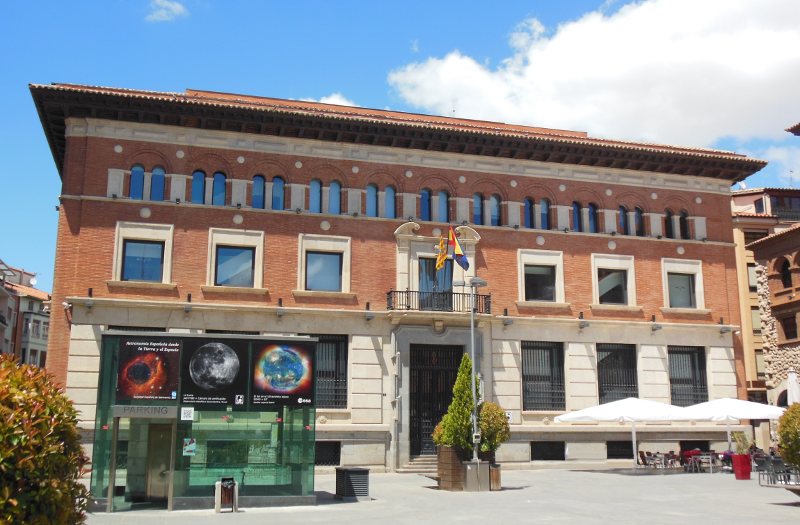
The conference talks will be held at the Events Hall of the building (i.e. "Salon de Actos") on the 4th floor (at street level by Calle San Francisco), and the coffee breaks and registration will be held at the Wall room (Sala La Muralla), with access by the park next to the train station, on the ground floor. The photo of the building on this page was taken from the park.

Lunch during the meeting will be included in the registration fee. It will normally be served at the basement floor of the CEFCA headquarters, located at Plaza de San Juan 1, 44001, at 5 min walking distance from the Gobierno de Aragon Local Government office building. The photo below shows a picture of CEFCA headquarters taken from the center of Plaza de San Juan.
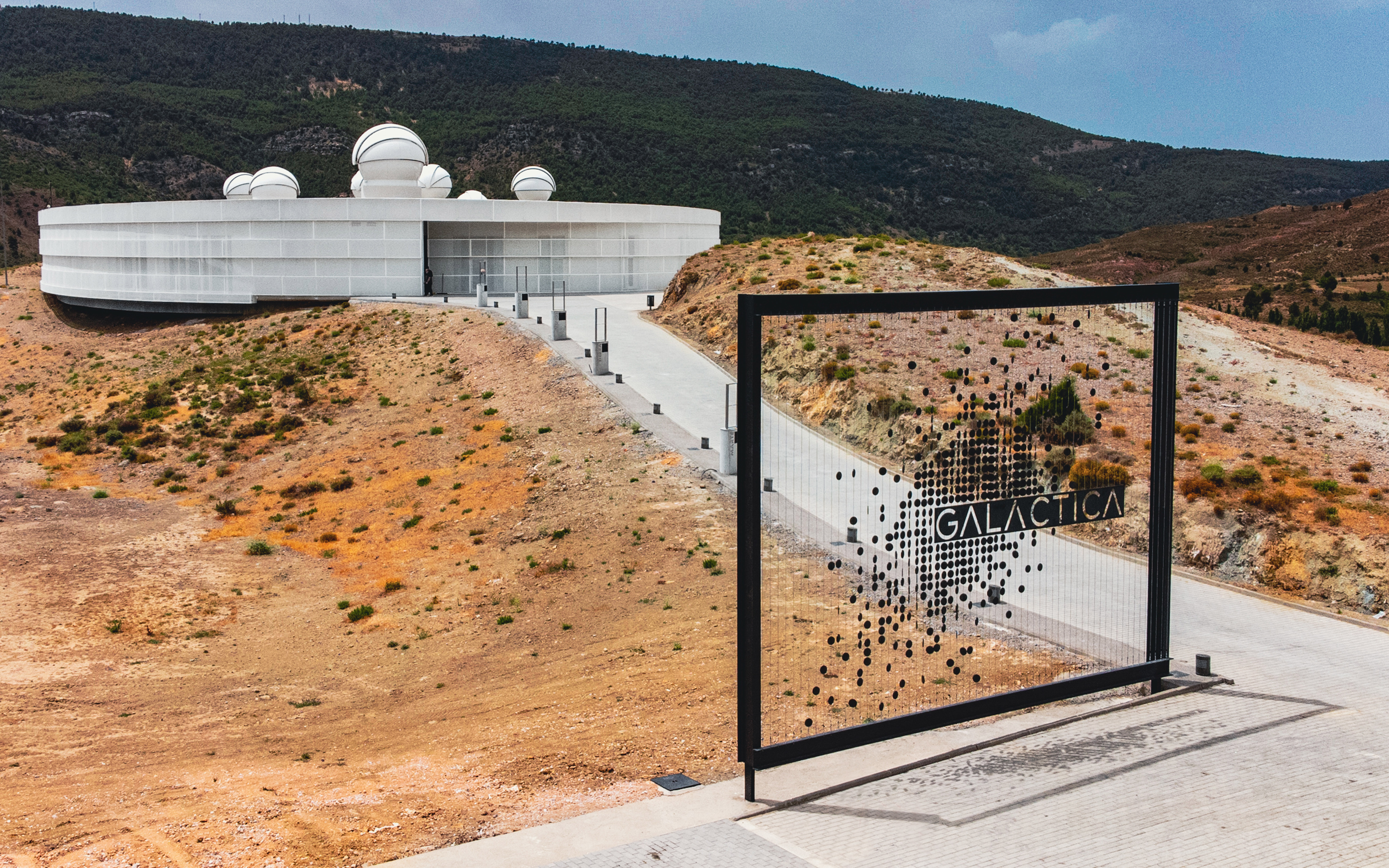
Additionally, in the morning of October 7th, the meeting will be held at Galáctica, the center for Outreach and Education in Astronomy of the Observatorio Astrofísico de Javalambre (OAJ), defined and constructed by CEFCA in the village of Arcos de las Salinas. Galáctica is 1h drive from Teruel. The conference organization will provide buses to take the participants to Galáctica and be back to Teruel by the end of the day. In the afternoon, after the conference sessions finish, there will be a free visit to the OAJ and to Galáctica for all the attendants.
Hotel Information
There are several hotels within walking distance to the conference venue. This page provides a list of nearby hotels with special prices for conference attendants.
1. GRAN HOTEL BOTÁNICOS****
- There is a special price for CEFCA: You must state that you are booking a room for attending the CEFCA meeting in October 2026.
- The room price for 1 or 2 people is 120 euros, accommodation only. The buffet breakfast is 13 euros per person. A parking space costs 12 euros.
- Included: IVA/TAX
- (0034) 978 623 957 | www.granhotelbotanicos.com | reservas@granhotelbotanicos.com
- These rates only apply when booking directly with the hotel (by phone or e-mail). In order to make the reservation, full name, contact mobile phone, e-mail address, credit card number and credit card expiration date will be required.
2. HOTEL PALACIO LA MARQUESA****
- There is a special price for CEFCA: You must state that you are booking a room for attending the CEFCA meeting in october 2026.
- Confort room (individual use): 158 € /night (with breakfast)
- Confort room (doble use): 176 € /night (with breakfast)
- Premium room (individual use): 172 € /night (with breakfast)
- Premium room (doble use): 190 € /night (with breakfast)
- Included: IVA/TAX
- (0034) 978 210 065 | www.hotelpalaciolamarquesa.com/en/
- These rates only apply when booking directly with the hotel (by phone or e-mail). In order to make the reservation, full name, contact mobile phone, e-mail address, credit card number and credit card expiration date will be required.
3. HOTEL MUDAYYAN***
- There is a special price for CEFCA: You must state that you are booking a room for attending the CEFCA meeting in October 2026.
- The book must be made by emailing the hotel directly.
- Double room (single use): 65 €/night (with breakfast)
- Double room: 75€ /night (with breakfast)
- Included: IVA/TAX
- (0034) 978 623 042 | www.elmudayyan.com | info@elmudayyan.com
- These rates only apply when booking directly with the hotel (by e-mail).
4. HOTEL WELCOME TERUEL***
- There is a special price for CEFCA: You must state that you are booking a room for attending the CEFCA meeting in October 2026.
- The book must be mail by emailing the hotel directly.
- Double room (single use): 65 €/night (with breakfast)
- Double room: 75€ /night (with breakfast)
- Included: IVA/TAX
- (0034) 978 087 165 | welcometeruel.com | info@welcometeruel.com
- These rates only apply when booking directly with the hotel (by e-mail).
Of course, many other possibilities exist for your accomodation in Teruel. Please check the Siente Teruel website, and do not hesitate to contact us if you need any further assistance.
Transportation & Travel Information
Nearby international airports and options to get to Teruel:
Teruel is located in the middle point between big cities such as Madrid (300 km), Barcelona (410 km), Valencia (140 km) and Zaragoza (180 km). It does not have an airport but can be easily reached from all the international hubs of these bigger cities. The available options for landing in Spain are, in order of increasing distance from Teruel:
- Valencia: https://www.aeropuerto-valencia.com/
- Zaragoza: https://www.aena.es/en/zaragoza.html
- Madrid-Barajas: https://www.aeropuertomadrid-barajas.com/
- Barcelona-El Prat: https://www.aeropuertobarcelona-elprat.com/
Once you are in one of these cities, you can easily reach Teruel either by bus, train or car. The options are listed below, in order of travel time. The parenthesis mark the approximate “effective travel time” (i.e. not counting stops or transfers between lines):
- Plane flight to Valencia → then: car rental + car trip (1.5hr) / bus (2hr) / train (2.5hr)
- Plane flight to Zaragoza → then: car rental + car trip (1.75hr) / bus (2hr) / train (2.5hr)
- Plane flight to Madrid → then: bus (3-5hr) / train to Zaragoza + bus (4hr) / car rental + car trip (4.5hr) / train to Zaragoza + train to Teruel (4.5hr)
- Plane flight to Barcelona → then: train to Zaragoza + bus (3-4hr) / car rental + car trip (4-5hr) / train to Zaragoza + train (4-54hr) / bus to Zaragoza + bus (5-6hr)
Below you can find details on all the possible paths and means of transportation which you can choose from either Valencia, Zaragoza, Madrid or Barcelona.
How to get from the airports to bus/train stations:
Valencia:
The Valencia bus station is located next to the “Turia” underground station (on line 1). In order to get to Turia station, take either underground line 3 (red line) or line 5 (green line) from the airport station (head of both lines) and transfer to line 1 (yellow line, directions “Bétera - Llíria - Paterna - Empalme”) at the Àngel Guimerà underground station.
Trains to/from Valencia leave the city from “Estació del Nord” station. In order to reach it from Valencia airport take line 3 (red line) and get off at “Xátiva” station. No transfers are needed.
Zaragoza:
Buses and trains to/from Zaragoza are both operated from the “Delicias” station. In order to reach the train/bus terminal from the airport you just need to take the 501 bus at Zaragoza airport, which is a direct line operating on the Airport - Estación Delicias route. No transfers are needed.
Madrid:
Buses leave Madrid only from “Madrid-Estacion Sur” bus station. To reach it from Madrid-Barajas airport it is necessary to take the metro line 8 (pink line direction ‘’Nuevos Ministerios’’), and change to line 6 (grey line direction ‘’Mendez Álvaro”) at ‘’Nuevos Ministerios’’ station.
Trains leave Madrid from “Atocha” train station. Take line 8 (pink line) from Madrid-Barajas airport (direction “Nuevos Ministerios”) and transfer to line 6 (grey line) in order to get to “Cuatro Caminos” station (1 stop away from “Nuevos Ministerios”). Transfer to line 1 (cyan line) direction “Valdecarros” and get off in “Atocha - RENFE” underground station.
Barcelona:
Buses and trains to/from Barcelona are both operated from “Barcelona - Estacion Nord” station. In order to reach it, take the “Aerobus” service from any terminal at Barcelona airport and transfer to the underground line 1 (direction “Fondo”) in the “plaza Espanya” station of Aerobus. The closest stop to “Barcelona - Estacion Nord” on line 1 is the “Arc de Trionf” underground station.
By Bus
Teruel bus station (website) | Ronda de Ambeles, s/n 44001 Teruel (España) | Tel. 978 610 789 | 24h Information: 671 304 178
From Valencia:
The company which connects Valencia to Teruel by bus is called IRB (International regular bus, website). Tickets for this trip can be booked at the company’s website. The trip takes approximately 2 hours.
From Zaragoza:
The bus company which connects Zaragoza to Teruel is called AUTOBUSES JIMENEZ (website). The trip can take either 2 hours or 2 hours and 30 minutes, depending on the particular hour selected in the bus schedule.
From Madrid:
The company which connects Teruel and Madrid by bus is called IRB (International regular bus, website). The trip can last from a minimum of 3 hours and 30 minutes, up to 5 hours and 30 minutes, depending on the particular hour selected.
From Barcelona:
The fastest option to reach Teruel from Barcelona by bus is to follow the itinerary Barcelona-Zaragoza-Teruel which includes a transfer in Zaragoza. Tickets for the Barcelona-Zaragoza section of the trip can be bought at the ALSA company website. The trip to Zaragoza takes more or less 3-4 hours. For information about the Zaragoza-Teruel section of the trip see the “From Zaragoza” point (above).
By train
All possible information about routes, schedules and reservations regarding trains from either Valencia, Zaragoza, Madrid or Barcelona can be found at the website of the spanish train company: Renfe.
General information to the customer: 902 320 320
Shopping Online Information: 902 109 420
The only two cities directly connected with Teruel by train are Zaragoza and Valencia. In both cases, the trip lasts approximately 2 hours and 30 minutes, as there is no high-speed route connecting Teruel to neither Zaragoza nor Valencia. In case you are planning to reach Teruel by train from Madrid you will have to transfer at Zaragoza whereas if you are planning to start from Barcelona you will need to change either at Valencia or Zaragoza. Tickets for both Valencia-Teruel and Zaragoza-Teruel itineraries are usually available 1-2 months before the travel date, whereas tickets for Barcelona-Zaragoza, Barcelona-Valencia and Madrid-Zaragoza routes are available with larger advance. We suggest you to check carefully the availability of the trip you intend to choose. All RENFE customer-care services and useful telephone numbers can be found here (SPANISH ONLY):
Customer Service: www.renfe.com/es/en
By Car
Teruel can be easily reached by car from either Zaragoza or Valencia, as the A-23 highway connecting Valencia to Zaragoza passes very close by Teruel. If you come from Madrid there are 2 possibilities: 1) all-highway paths or 2) itineraries including national roads. If you come from Barcelona you can pass by either Zaragoza or Valencia. More detailed information about the different itineraries can be found below, in order of increasing travel-time:
Valencia - Teruel (only-highways path, 1 hour 30 minutes)
From either Valencia airport or train station follow directions to the A-7 (or AP-7) higwhay (DIRECTION SAGUNT-CASTELLON-BARCELONA). Once on the A7/AP-7, follow the directions to Teruel (or A-23 highway, Autovia Mudéjar). To exit the A-23 highway, take the first exit available for Teruel (i.e “Teruel sur”). You will arrive in the city center after few kilometers of national road.
Zaragoza - Teruel (only-highways path, 1 hour 45 minutes)
From either the Zaragoza airport or train station follow the directions to the Z-40 highway (i.e the Zaragoza bypass which goes all around the city). From the Z-40 it’s very easy to converge to the A-23 highway (Autovia Mudéjar) which will take you directly to Teruel. Once you reach Teruel, take the exit for the city center (“Teruel - centro ciudad”, i.e. the second exit available). Car rental services are available both at Zaragoza train station and airport (see links below).
Madrid - Teruel (highways + national-roads path, 3 hours 30 minutes)
From either Madrid airport or train station follow directions to A-2 highway (direction Zaragoza). Once in “Alcolea del Pinar” follow the directions to N-211 national road - “Molina de Aragon - Teruel”. You will reach “Monreal del campo” and connect to the A-23 (direction Teruel) after 110 km. Once you reach Teruel, take the exit for the city center (“Teruel - centro ciudad”, i.e. the second exit available).
Madrid - Zaragoza - Teruel (only-highways path, 4 hours)
From either Madrid airport or train station follow directions to A-2 highway (direction Zaragoza). Once in Zaragoza follow the directions to Teruel (A-23 highway). You might have to take the Z-40 connecting highway before being able to get on the A-23. Once you reach Teruel, take the exit for the city center (“Teruel - centro ciudad”, i.e. the second exit available).
Barcelona - Castellon - Teruel (only-highways path, 4 hours 20 minutes)
From either Barcelona train station or airport converge to the AP-7 highway, direction: Tarragona - Castellon - Valencia. Once you reach the city of Sagunt, follow the directions to Teruel, A-23 highway (Autovia Mudéjar). To exit the A-23 highway, take the first exit available for Teruel (i.e “Teruel sur”). You will arrive in the city center after few kilometers of national road.
Barcelona - Zaragoza - Teruel (only-highways path, 4 hours 40 minutes)
From either Barcelona train station or airport converge to the A-2 highway (direction Lleida - Igualada - Fraga). Once you get to Fraga, follow the directions to AP-7 highway (direction Zaragoza). Once in Zaragoza follow the directions for Teruel, A-23 highway (you might have to take the Z-40 bypass which goes all around Zaragoza). Follow the A-23 until you reach Teruel and take the exit for the city center (“Teruel - centro ciudad”, i.e. the second exit available).
Car rental services are available in Madrid, Barcelona, Valencia and Zaragoza. Here are links to the websites of some diffuse car-rental companies:
- AVIS (www.avis.es). Reservations Phone Number: 902 180 854
- EUROPCAR (www.europcar.es). Reservations Phone Number: 902 105 055
- HERTZ (www.hertz.es). General information and bookings telephone number: 902 402 405
- SIXT (www.sixt.es). General information and bookings telephone number: 902 491 616
Visa
If you come from a country in the following list, you will need a visa in order to enter in Spain or any other European country:
Afghanistan, Albania, Algeria, Angola, Armenia, Azerbaijan, Bahrain, Bangladesh, Belarus, Belize, Benin, Bhutan, Bolivia, Bosnia & Herzegovina, Botswana, Burkina Faso, Burundi, Cambodia, Cameroon, Cape Verde, Central Africa Republic, Chad, China, Comoros, Congo, Cuba, Democratic Republic of Congo, Djibouti, Dominican Republic, East Timor, Ecuador, Equatorial Guinea, Egypt, Eritrea, Ethiopia, Fiji, Gabon, Gambia, Ghana, Guinea, Guinea-Bissau, Guyana, Haiti, Hong Kong (when it is not SAR), India, Indonesia, Iran, Iraq, Ivory Coast, Jamaica, Jordan, Kazakhstan, Kenya, Kyrgyzstan, Kuwait, Laos, Lebanon, Lesotho, Liberia, Libya, Madagascar, Malawi, Maldives, Mali, Mauritania, Mongolia, Morocco, Mozambique, Myanmar, Namibia, Nauru, Nepal, Niger, Nigeria, North Korea, Oman, Pakistan, Palestine, Papua New Guinea, Philippines, Qatar, Russia, Rwanda, Sao Tome, Saudi Arabia, Senegal, Sierra Leone, Somalia, South Africa, South Sudan, Sri Lanka, Sudan, Suriname, Swaziland, Syria, Tajikistan, Tanzania, Thailand, Togo, Tunisia, Turkey, Turkmenistan, Uganda, Uzbekistan, Vietnam, Yemen, Zambia, Zimbabwe.
The starting point is the website of Spanish ministry of exterior:
English version: https://www.exteriores.gob.es/Portal/en/Paginas/inicio.aspx
Spanish version: https://www.exteriores.gob.es/Portal/es/Paginas/inicio.aspx
If the english versions does not appear, please select the language by clicking the “Welcome” button on the top of the page (in the spanish version).
Please, remember that since you will need a short term visa, you have to select the “Uniform Schengen Visa” link. Note: The Schengen visa is a document that can be obtained in any country that takes part of Schengen space (Austria, Belgium, Czech Republic, Denmark, Estonia, Finland, France, Germany, Greece, Hungary, Iceland, Italy, Latvia, Lithuania, Luxembourg, Malta, Netherlands, Norway, Poland, Portugal, Slovakia, Slovenia, Spain, Sweden, Switzerland, Liechtenstein).
If you have any issue, please do not hesitate to contact us.
Organizer

Collaborators