

ARRAKIHS, the first ESA Scientific Mission led by Spain and supported by CEFCA, moves into its development phase
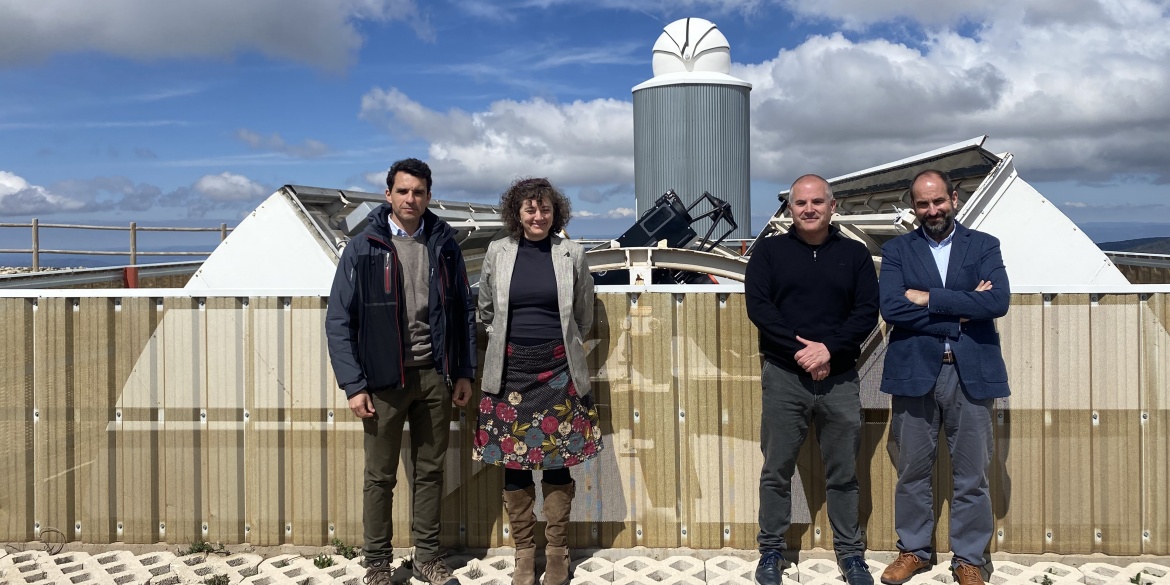
OGD of ARRAKIHS mision that now is located in Observatorio Astrofísico de Javalambre
ARRAKIHS, the first mission in the European Space Agency (ESA) Science Programme to be led by Spain through the Ministry of Science, Innovation and Universities (MICIU) and the Spanish Space Agency (AEE), has today officially entered its development phase ahead of its planned launch in 2030.
As of today, ARRAKIHS officially becomes the F2 mission within ESA’s Science Programme, marking the culmination of a process that began with its selection in 2022. This decision represents a new milestone for the first ESA scientific mission led by Spain and further strengthens the country's position at the forefront of European space exploration.
“With ARRAKIHS, Spain is taking its place on the front line of European space exploration,” said the Minister of Science, Innovation and Universities, Diana Morant.
“This is a mission that generates knowledge, strengthens our industrial ecosystem, attracts talent and showcases our country's capabilities internationally,” Minister Morant stated, adding that “the advances this mission will bring in understanding how galaxies form and the nature of dark matter will bear the Spanish hallmark.”
F (Fast) missions are a category within ESA’s Science Programme designed to be developed on shorter timescales and with lower costs than the Agency’s large-scale missions, enabling a more agile response to emerging scientific challenges. ARRAKIHS is the second mission selected under this programme and the first to be led by Spain.
Adoption is the formal decision by which ESA authorises a mission to move from the design phase into the development and construction phase.
The decision has been approved by the Member States meeting at the Science Programme Committee (SPC), taking place today and tomorrow in Tenerife under the chairmanship of Cecilia Hernández, Director of Programmes and Industry at the Spanish Space Agency (AEE).
Prior to this decision, independent scientific committees and ESA advisory bodies assessed the mission’s scientific objectives and technical feasibility. ARRAKIHS has also successfully completed all required conceptual and preliminary design phases, culminating in the successful Preliminary Design Review (PDR), which certifies its readiness to proceed to detailed design, manufacturing, integration and validation of both the satellite and its scientific instrument.
Revealing the Faint Universe
ARRAKIHS was selected by ESA in 2022 as a candidate to become the second F-class mission within its Science Programme. Since then, the mission has successfully completed all definition and preliminary design stages required by the Agency, demonstrating its scientific, technical and programmatic feasibility.
The mission was conceived to address one of the major open questions in modern astrophysics: how galaxies form and evolve within dark matter haloes. To achieve this, it will observe with unprecedented sensitivity the diffuse stellar haloes of low surface brightness that surround galaxies such as the Milky Way.
ARRAKIHS will open a new window onto the so-called low surface brightness Universe, enabling the study of structures that have so far remained largely hidden and providing new insights into dark matter, galactic mergers and galaxy evolution.
From Concept to Mission
Since its selection by ESA in 2022, ARRAKIHS has successfully completed all the stages required to become a fully established mission within the European Science Programme. During this period, the international consortium has completed the preliminary design of the satellite and its instruments, developed new cosmological simulations and galactic models, validated key technologies, and strengthened the mission’s scientific potential through increasingly deep observations of the low surface brightness Universe.
With its official adoption as the F2 mission, ARRAKIHS now leaves the definition phase behind and enters the development and construction stage. Its planned launch in 2030 will mark the beginning of a mission set to transform our understanding of galaxy formation and the nature of dark matter, while further consolidating Spain’s scientific, technological and industrial leadership within the European space sector.
The ARRAKIHS Mission
The ARRAKIHS scientific team is led by Rafael Guzmán, Research Professor at the Institute of Physics of Cantabria (IFCA), a joint centre of the Spanish National Research Council (CSIC) and the University of Cantabria (UC).
The ARRAKIHS mission (an acronym for “Analysis of Resolved Remnants of Accreted Galaxies as a Key Instrument for Halo Surveys”) was submitted to ESA’s Fast Missions Opportunities (F-Missions) programme in February of that year. Its development involves an international consortium comprising research institutions from Spain, Switzerland, the United Kingdom, Belgium, Sweden, Austria and the United States, in response to ESA’s call for proposals published in December 2021. Subsequently, in July, the mission received support from the then Ministry of Science and Innovation through its participation in ESA’s PRODEX programme, managed by the Centre for the Development of Industrial Technology (CDTI).
An Astronomical Milestone
For the mission, the Spanish company Satlantis has designed and developed a visible and infrared binocular camera that will make it possible to obtain images of one hundred Milky Way-like galaxies, reaching surface brightness levels between 5 and 100 times deeper than the best images currently obtained from ground-based observatories. The depth, resolution and wide field of view provided by ARRAKIHS will represent a major astronomical milestone and deliver key information for advancing our understanding of dark matter in the Universe.
The Javalambre Astrophysical Observatory, the Mission’s First Home
The Centre for the Study of the Physics of the Cosmos of Aragon (CEFCA) is part of the consortium managing the ARRAKIHS mission, and the Javalambre Astrophysical Observatory (OAJ) has been collecting the mission’s first data for the past year.
The iSIM-170 binocular camera, a replica of the instrument that will eventually be launched into space, is installed at the OAJ to test and validate the mission’s observing strategies and data analysis procedures. From Teruel, several of the galaxies that will later be studied from space are already being observed. Following the mission’s launch in 2030, this ground-based demonstrator will continue to support the spaceborne instrument through complementary observations carried out from Javalambre.