

Major international astronomical surveys come together in Teruel
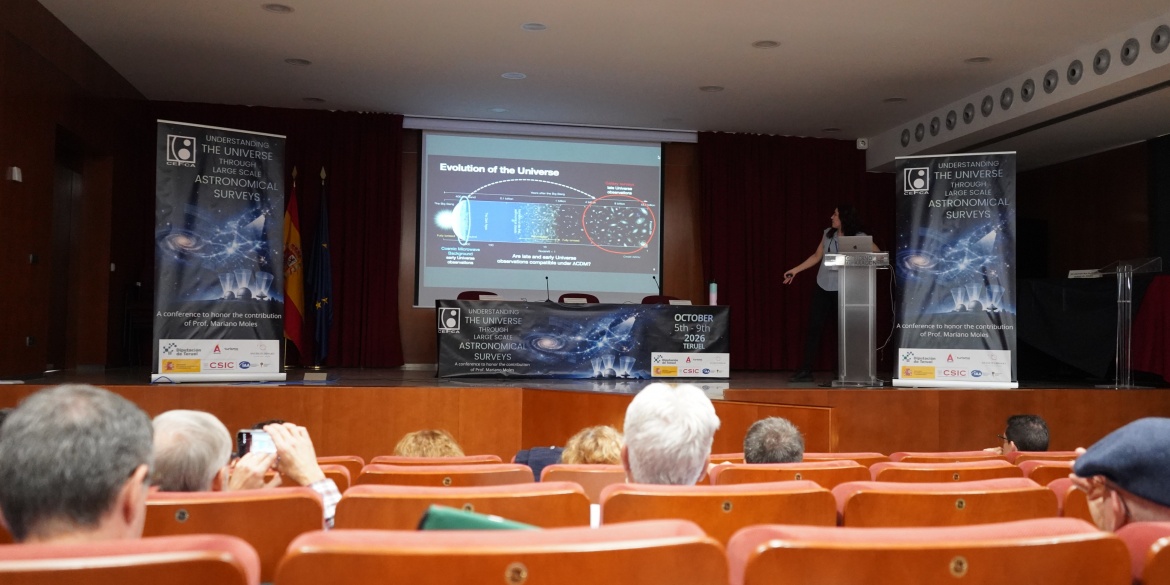
Major international astronomical surveys come together in Teruel
“Our main aim is to create a forum for scientific discussion around major astronomical surveys,” Javier Cenarro, Director of the Centro de Estudios de Física del Cosmos (CEFCA), told the press. The conference “Understanding the Universe through large scale astronomical surveys” is now under way, bringing together 20 international projects seeking to understand the Universe on a large scale. A shared conviction underpins the meeting: “Collaboration between projects with different objectives can be very rewarding when their data are combined,” Cenarro explained. “We have sought to take a broad perspective and identify synergies and opportunities for collaboration,” the CEFCA Director added.
Rosa María Sánchez, the Government of Aragón’s representative in Teruel, attended the opening ceremony and welcomed the researchers to the city. She was joined by Javier Cenarro and María Jesús Lázaro, the Spanish National Research Council’s (CSIC) representative in Aragón, who noted that “Aragón’s scientists are highly regarded, and CEFCA is one of the region’s pioneering projects”. The CSIC representative also called on institutions “to work together to raise awareness of the value of science and help people distinguish science from pseudoscience”.
The conference opened with a presentation on DESI (Dark Energy Spectroscopic Instrument), which completed its initial observing programme in 2026 and has observed more than 47 million galaxies and quasars. This perspective is complemented today by the challenges facing eROSITA, an all-sky X-ray survey carried out by an instrument launched aboard a satellite in 2019. Another highlight this afternoon is Gaia, a mission that completed its observations in 2025 and is now focused on processing and analysing its data.
The contribution of J-PAS
The CEFCA team has chosen the conference to announce a new data release, which will bring the total publicly available coverage of this survey, conducted at the Observatorio Astrofísico de Javalambre, to 30 square degrees. This is the second release since the project began operations and “shows that the project is gathering pace”, Javier Cenarro explained during the presentation, while also demonstrating “the outstanding quality of the data”. A distinctive feature of this survey is that it provides information for every observed position through 56 filters, using the 1,200-megapixel JPCam, one of the world’s most powerful astronomical cameras.
This afternoon will also feature the contribution of J-PLUS, the other major survey conducted at Javalambre. It has already made 5,000 of its planned 8,000 square degrees available to the scientific community, passing the halfway mark towards its coverage goal. Dozens of scientific papers already explore the contributions and discoveries emerging from J-PAS and J-PLUS data.
The contribution of Mariano Moles
Thursday morning’s session will explore the contribution of Mariano Moles. Moles, who attended the conference opening, stressed that CEFCA “has already exceeded even the most optimistic expectations”. The centre’s founding director explained that “it has become established within the international scientific community far sooner than anticipated, produces data of the highest quality and has received widespread recognition”.
Born in Binaced (Huesca), Moles worked at the French National Centre for Scientific Research, served as Co-Director of the German–Spanish Astronomical Centre at Calar Alto and joined the CSIC as a researcher at the Instituto de Astrofísica de Andalucía, which he later directed. He was also a driving force behind the creation of CEFCA and served as its Director, playing a key role in projects such as ALHAMBRA, WINGS and the J-PAS and J-PLUS surveys, whose scientific achievements will be discussed at the conference.
The conference also offers an extensive social programme, including the talk “La geometría del pecado” (“The Geometry of Sin”) by CSIC astrophysicist Emilio J. Alfaro. The talk will be open to the public and will take place at the Auditorio de San Julián on Tuesday 6 October at 19:00. Drawing on details from major works of medieval culture, it explores how people understood the Universe eight centuries ago, connecting geometry and cosmology with art and thought.