

Over 6,500 asteroids detected under the J-VAR project
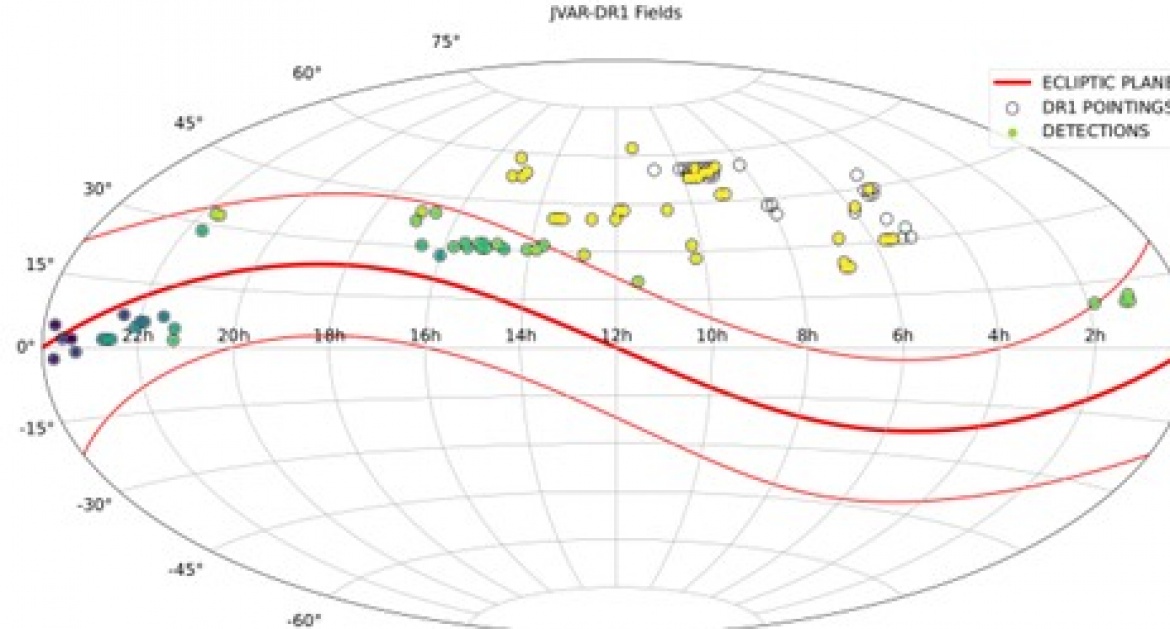
Crédits: D. Morate /CEFCA
Attention turns to the Local Universe, to the same sky mapped by J-PLUS, but this time to search for objects whose brightness or position changes. The Javalambre Variability Survey (J-VAR) examines the sky visible from the Javalambre Astrophysical Observatory (OAJ) using the JAST80 telescope, the first large telescope incorporated into this Spanish ICTS. For the first time, J-VAR has taken stock: a total of 6,579 Solar System minor bodies are now included in a catalogue that is already available to the scientific community on the CEFCA website.
J-VAR observes regions of the sky already characterised by J-PLUS and revisits them up to 11 times, with a cadence that can range from a few days to a year. Among the more than 6,500 objects observed, 17 Near-Earth Asteroids (NEAs) have been detected, for instance. The results demonstrate the project’s capability to detect minor bodies. The catalogue is presented in a paper led by David Morate González, a postdoctoral researcher at CEFCA.
It is worth noting that J-VAR is a photometric survey carried out at the Javalambre Astrophysical Observatory, in Teruel (Spain). Observations are performed with the T80Cam camera on the JAST80, using a subset of seven of the 12 filters from the main project, J-PLUS. In this first data release, the project has compiled data from more than 30,000 images across 101 sky fields. J-VAR observations began in May 2017. Ninety-five per cent of the detected minor bodies belong to the main asteroid belt.
The work includes not only catalogues of individual detections and combined magnitudes, but also preliminary analyses of the spectrophotometric properties of asteroids, comparisons with data from other missions—such as Gaia—and the construction of partial lightcurves to investigate rotational variations.
This catalogue demonstrates J-VAR’s potential as a tool for studying minor bodies, as it combines multi-epoch observations with multi-filter photometry. Planned next steps include developing more detailed taxonomic classifications, exploring objects with unusual spectral characteristics, and using the data to help correct asteroid spectra from other missions.
For postdoctoral researcher David Morate, “the work confirms that, although J-VAR’s main objective focuses on other areas of astronomy, it is a valuable tool for the characterisation and discovery of small Solar System bodies.”