

CEFCA researchers within the “Library of Alexandria” of software
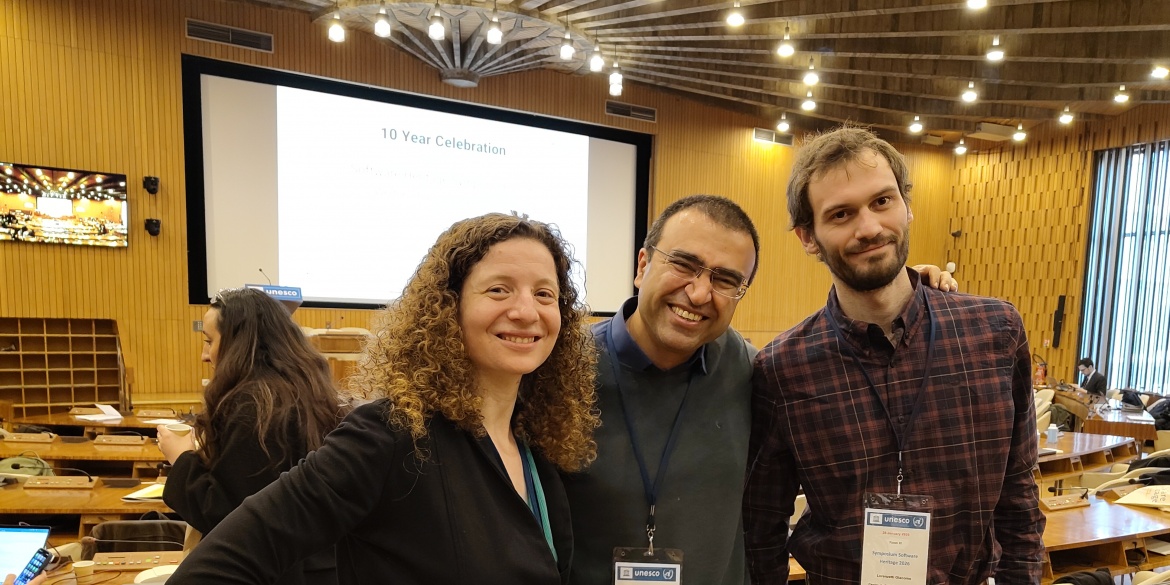
Morane Grunpeter (left), Head of Open Science Operations at Software Heritage, with Mohammad Akhlaghi (centre) and Giacomo Lorenzetti (right), during the annual Software Heritage meeting at the UNESCO headquarters in Paris
Free and open source software (FOSS) are a core component of the operations and scientific analysis of data obtained at CEFCA’s Astrophysical Observatory of Javalambre. Some of this software is written and maintained by CEFCA staff, made available as FOSS and used by other resarchers and observatories. This is the case of Gnuastro and Maneage, which are core components of the research carried out at CEFCA.
The authors of both projects—CEFCA researcher Mohammad Akhlaghi and research software engineer Giacomo Lorenzetti—were invited to the annual Software Heritage meeting at UNESCO headquarters on 28 January.
Software Heritage is an initiative by the French National Institute for Research in Digital Science and Technology (INRIA) and is supported by UNESCO, IBM, Microsoft, Huawei, the French National Centre for Scientific Research (CNRS), among many other governmental and private institutions. Its aim is to preserve the source code of all available free and open source software, in a role comparable to that of the Library of Alexandria for written knowledge.
Software is extremely fragile—it can become inaccessible simply because a website goes offline or inaccessible—so the goal of treating software as a form of human heritage, like architecture or literature, is particularly important. At CEFCA, Software Heritage is used as part of our commitment to research reproducibility: the analysis carried out in this team’s —which includes Sepideh Eskandarlou and Raul Infante-Sainz— scientific papers is archived there and linked directly in the publications. Allowing other researchers to easily access the low-level source code behind the analysis of their published research results.
At this year’s meeting, it was also announced that the Instituto Madrileño de Estudios Avanzados en Tecnologías de Desarrollo de Software (IMDEA) will act as a “mirror” (a live copy) of Software Heritage for the Spanish community.
CEFCA’s work on free and open source software and its presence at UNESCO were partly covered by two grants from the Spanish State Research Agency (AEI) to CEFCA: ARRAKIHS (PID2022-138896NA-C54, led by Helena Domínguez-Sánchez) and STREAMDECODE (PID2024-162229NB-I00, led by Mohammad Akhlaghi), as well as by support from INRIA.