

J-PAS prepares its next data release at meeting in China
J-PAS prepares its next data release at meeting in China
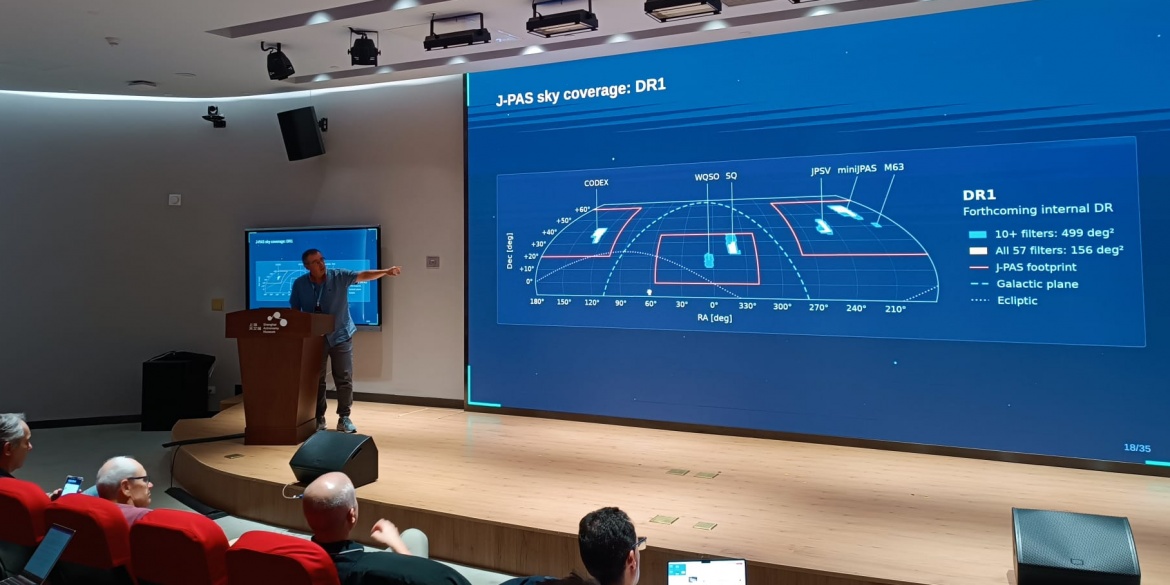
J-PAS is approaching an early milestone. Before the end of the year, collaboration members will gain access to 500 square degrees of the three-dimensional map being compiled from the Observatorio Astrofísico de Javalambre (OAJ). This will be the survey’s first regular data release (DR1), following preliminary releases in 2024 and a few weeks ago. The increase in coverage will be substantial: from the 28 square degrees made available in the Extended Early Data Release (E2DR), the survey will now offer 150 square degrees observed through the full set of J-PAS filters, within a total footprint of 500 square degrees with varying filter coverage.
Details of the release will be presented at the annual meeting of the international consortium coordinating J-PAS, whose Spanish partners are led by the Centro de Estudios de Física del Cosmos de Aragón (CEFCA) and the Instituto de Astrofísica de Andalucía (IAA-CSIC). China takes centre stage as it hosts this scientific meeting for the first time. The event provides an opportunity to learn about the latest technological developments and upcoming scientific projects in the country, and to explore potential collaborations.
The opportunity works both ways: the meeting has been opened to the wider Chinese scientific community. Participants include researchers from Beijing Normal University, the Institute of Theoretical Physics of the Chinese Academy of Sciences, and Shanghai Jiao Tong University (SJTU), among other institutions. The Chinese research community is well represented, with scientists from Yunnan, Tsinghua and Xiamen universities, as well as the National Astronomical Observatories of the Chinese Academy of Sciences. The meeting opened yesterday at the Shanghai Astronomy Museum and runs until 23 October, bringing together 58 researchers.
China joined J-PAS in late 2019, contributing US$800,000 and bringing 18 researchers into the collaboration. Like other collaboration members, they receive access to the scientific data several months before their public release, allowing them to conduct the first scientific analyses before the data become available to the international research community. Alongside China and Spain, Brazil, Estonia, Italy and Germany are also represented at the meeting by researchers involved in the project.
The annual meeting reviews the survey’s progress, the quality of the data obtained from observations at Javalambre, and ongoing scientific projects, while also seeking to establish new collaborations. A new addition to the programme is a talk introducing Galáctica’s science and public engagement activities. In total, the programme comprises 30 talks and 10 discussion sessions.