

More than 100 professionals trained in Teruel on how to report on eclipses
More than 100 professionals trained in Teruel on how to report on eclipses
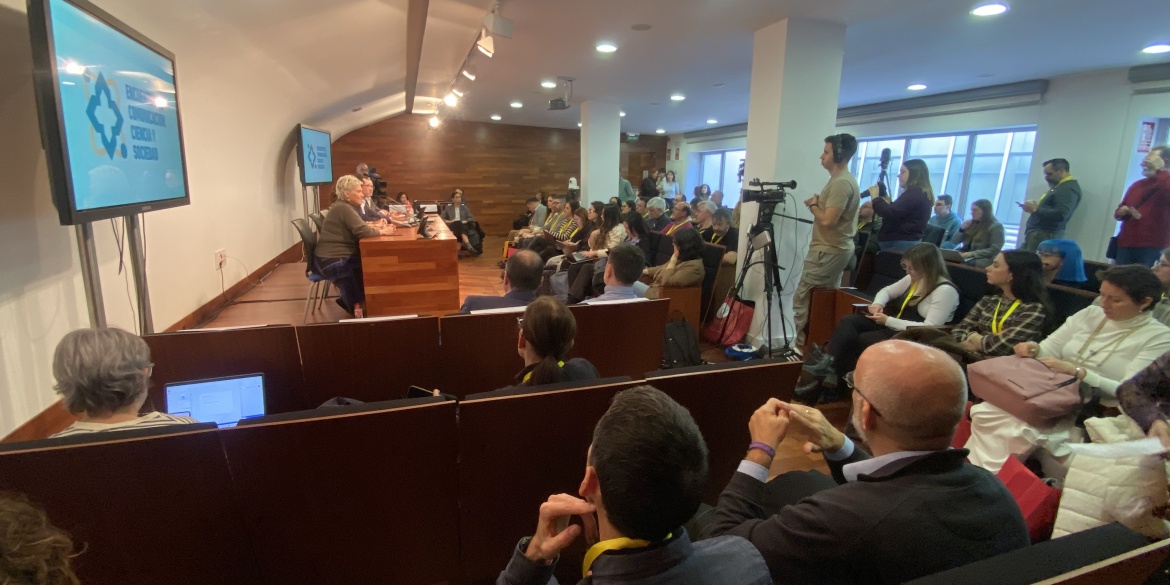
Some 60 professionals attended in person the first event in Spain to combine science communication and eclipse coverage. Under the slogan “Astrojournalism: Communicating Eclipses”, the meeting also connected with around 100 additional participants online at different moments. In total, 11 autonomous communities were represented, including many local, regional and specialised media outlets that will cover the eclipse in the Valencian Community and Aragón.
During the opening session, CEFCA Director Javier Cenarro highlighted the scientific work carried out in Teruel, particularly by his institution both in the city and at the Observatorio Astrofísico de Javalambre (OAJ), located in Arcos de las Salinas. “The Observatory was incorporated in 2014 by the Ministry of Science into Spain’s Map of Unique Scientific and Technical Infrastructures (ICTS), a distinction that recognises it as part of the country’s national scientific and technical heritage,” he noted.
Held at CEFCA’s headquarters in Teruel, the meeting also provided many visiting professionals with first-hand insight into the centre’s facilities and projects. In fact, Galáctica took centre stage on the second day. The session dedicated to the safe observation of eclipses was delivered at this outreach and observation centre in Arcos de las Salinas. The programme included a guided tour specifically tailored for communicators, explaining how the centre’s contents were selected and structured.
A scientific and institutional approach to the total solar eclipse
The scientific explanation and institutional planning surrounding the upcoming 12 August solar eclipse were central themes of the opening lectures.
In his keynote talk, “The Eclipse Trio”, Javier Cenarro described a phenomenon that will last just 94 seconds at maximum totality yet leave a lasting impression on all who witness it. According to the Scientific Advisory Committee for the Eclipse Trio, the 12 August eclipse is expected to draw the attention of around 10 million people worldwide.
Among the invited speakers was astrophysicist and renowned science communicator Javier Armentia, who explored why eclipses generate such widespread public interest. Meteorological forecasting was also addressed by astrophysicist Jorge Pérez-Gallego in his talk “How Do You Broadcast an Eclipse to Millions? Art, Education and Science: Lessons from the American Eclipse.” Drawing on his experience leading the live broadcast of the 2024 eclipse for the National Science Foundation (NSF) and the National Solar Observatory (NSO), Pérez-Gallego shared practical insights with attendees.
Rosa Capeans, Director of Scientific Culture and Innovation at the Spanish Foundation for Science and Technology (FECYT), delivered the lecture “How Does a Country Prepare for a Solar Eclipse?” In her presentation “Science Journalism and the Eclipse Trio,” journalist Pampa García Molina—Director of Science Media Center España and Vice-President of the Spanish Association of Science Communication—emphasised that covering high-impact scientific events “requires speed, accuracy and responsibility.”
This professional gathering, organised by the Asociación de Periodistas de Aragón and CEFCA, is sponsored by the Provincial Council of Teruel through the Siente Teruel brand, Turismo de Aragón and Teruel City Council, with the collaboration of Galáctica and Caja Rural de Teruel.
Strong media reach and national representation
The combined monthly audience of media outlets that published content related to the Meeting is estimated at around 50 million users. This figure does not include the viewers and listeners of broadcasters such as Onda Cero, Aragón Radio, TVE Aragón or the Valencian public broadcaster À Punt, among more than ten radio and television networks. Future reach is expected to grow further, considering the media organisations and science outreach entities that attended the event or followed the first day of lectures via streaming.
In total, more than 100 professionals from 11 autonomous communities participated: Andalucía, Aragón, Cataluña, Castilla-La Mancha, Comunidad de Madrid, Galicia, Islas Baleares, Islas Canarias, Navarra and Principado de Asturias. This broad representation highlights the national significance and social impact of a historic event that will be within reach of millions.
The total solar eclipse on 12 August will cross a wide swath of Spain, including municipalities in Galicia, Castilla y León, Asturias, Cantabria, the Basque Country, Navarra, Aragón, part of La Rioja, Castilla-La Mancha, the Valencian Community and will conclude in the Balearic Islands. The last total solar eclipse visible from the Iberian Peninsula took place in 1912.
CEFCA has expressed its satisfaction with the “excellent response from the media,” as stated by Luisa Valdivielso, Head of the institution’s Scientific Culture and Innovation Unit. “In addition to equipping professionals with the tools to cover the total solar eclipse and communicate these astronomical phenomena with rigour, the meeting has allowed us to showcase the top-tier facilities we host in Teruel—the Javalambre Astrophysical Observatory and Galáctica—as well as our research activity within the national landscape,” she added.