

Dwarf galaxies engage in cosmic "cannibalism"
Dwarf galaxies engage in cosmic "cannibalism"
Galaxies do not grow in isolation. According to the standard model of galaxy formation, even the smallest systems—so-called dwarf galaxies—should be surrounded by even fainter satellite galaxies that eventually merge with them over cosmic time. However, confirming this hierarchical assembly process observationally has so far proven extremely challenging.
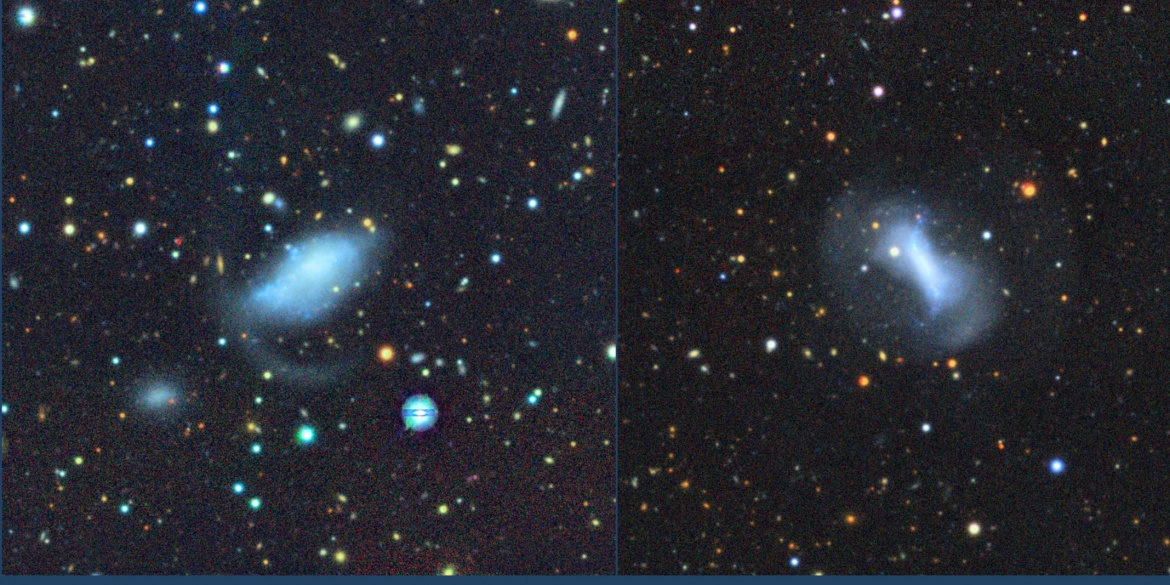
A new study published today in Astronomy & Astrophysics (A&A) makes significant progress in this direction by identifying 17 cases of accretion features—likely signatures of mergers with lower-mass satellite galaxies—around dwarf galaxies. The findings confirm that dwarf galaxies also grow through a process of galactic “cannibalism” and open a new observational window onto one of cosmology’s central mysteries: dark matter.
“For the first time, we have provided an estimate of how frequently dwarf galaxies exhibit stellar streams,” explains Joanna D. Sakowska, researcher at the IAA-CSIC and lead author of the study.
A Natural Laboratory for Dark Matter Studies
Dwarf galaxies are particularly compelling systems because they are strongly dominated by dark matter—an invisible component that constitutes most of the matter content of the Universe and whose fundamental nature remains unknown. The way dwarf galaxies merge, and the morphology of the tidal debris they leave behind, is highly sensitive to the underlying properties of dark matter.
In this context, David Martínez Delgado, CEFCA researcher and co-author of the study, notes that stellar streams are powerful tracers of the dark matter halos of their host galaxies. “Beyond their frequency, their morphology preserves the ‘frozen’ orbital configuration of their progenitor dwarf galaxy, offering a unique opportunity to constrain how much dark matter is required to account for their observed dynamics.”
One of the study’s most notable results is the identification of a stellar stream whose morphology can be successfully reproduced with theoretical models, allowing certain dark matter scenarios to be disfavored while supporting others. In addition, the work provides the first quantitative estimate of how often dwarf galaxies host such structures.
When One Galaxy Devours Another, It Leaves Traces
When a larger galaxy accretes a smaller companion, the merger is not instantaneous. Gravitational forces gradually strip stars from the satellite, dispersing them around the primary galaxy and forming recognizable structures such as stellar streams, shells, or asymmetric stellar halos. These tidal features have been observed relatively frequently in massive galaxies like the Milky Way, but confirmed examples in dwarf galaxies have been scarce.
In this study, the research team analyzed deep imaging data and compiled the first systematic catalog of accretion remnants in dwarf galaxies. The catalog includes one prominent stellar stream, eleven shell systems, and eight asymmetric stellar halos—17 of them newly identified features.
“We know these mergers must occur, but detecting them in such low-mass systems is extremely difficult,” explains Sakowska. “This work provides a first glimpse demonstrating that dwarf galaxies, too, retain visible scars of their past interactions.”
A Preview of What Lies Ahead
The study is part of the Stellar Stream Legacy Survey (SSLS), an international initiative aimed at building a large, homogeneous sample of stellar streams to enable robust comparisons between observations and theoretical predictions. The team conducted a visual inspection of dwarf galaxies using data from the Legacy Imaging Survey, one of the deepest wide-area imaging surveys available.
The results underscore both the observational challenges involved in detecting such faint features and the need to refine theoretical models of low-mass galaxy mergers. Nevertheless, they provide new observational constraints on how the smallest galaxies in the Universe assemble over time.
“We now have remarkable images of tiny galaxies ‘devouring’ even smaller companions,” concludes Sakowska. “This is just a preview of what future facilities such as Vera C. Rubin Observatory (LSST) will reveal, enabling us to detect even subtler signatures of galactic cannibalism. If future observations fail to match theoretical predictions, it could indicate that we need to revise our models of galaxy formation—or even reconsider the fundamental nature of dark matter itself.”