

CEFCA researchers take part in Oxford meeting seeking a unified theory of black holes
CEFCA researchers take part in Oxford meeting seeking a unified theory of black holes
Accretion onto black holes is not an isolated phenomenon, but a key driver in the evolution of galaxies and cosmic structures. This is the starting point of BlackHolistic, which aims to advance towards a unified framework that applies across the full range of black hole masses and accretion regimes. Such a framework seeks to bridge fundamental physics with galaxy evolution, connecting stellar-mass black holes—such as microquasars and X-ray binaries—with the supermassive black holes found in active galactic nuclei (AGN).
The meeting draws both its name and part of its support from the ERC Synergy Grant BlackHolistic, whose goal is to deepen our understanding of the link between accretion and jet formation in both stellar-mass and supermassive black holes. Among its initiatives is the construction of the Africa Millimetre Telescope in Namibia, which will enhance the imaging capabilities of the Event Horizon Telescope.
It also continues the SHIVA series of meetings, extending its focus on how these processes scale with black hole mass towards a broader perspective that includes their cumulative impact on galaxy evolution and the large-scale structure of the Universe.
CEFCA researchers’ contribution
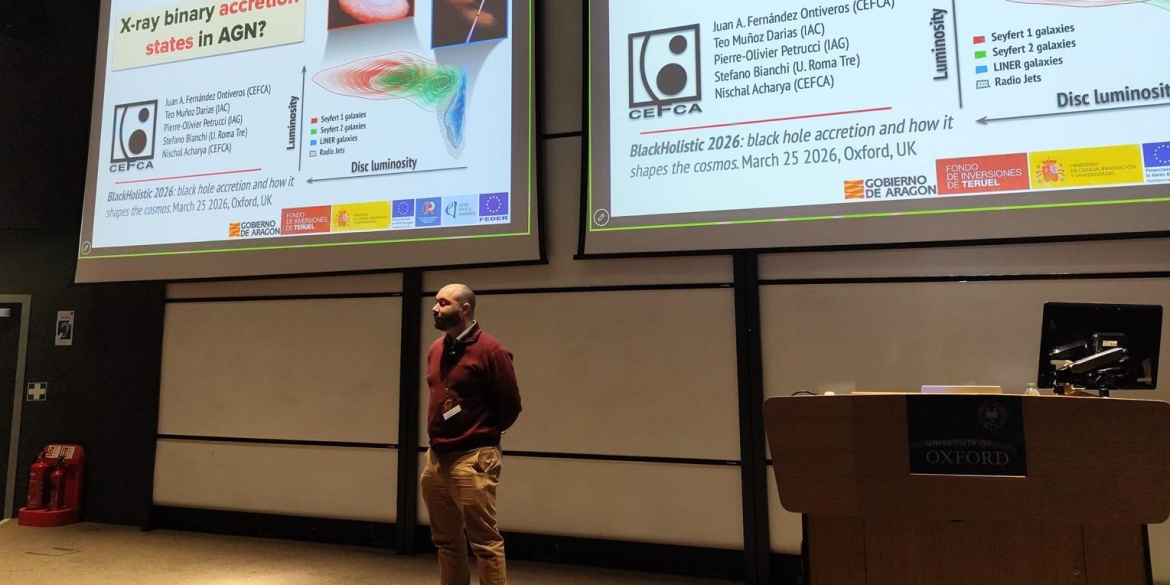
CEFCA researcher Juan Antonio Fernández Ontiveros presents the contribution “Tracing Accretion State Transitions in AGN: Insights from Photoionisation Simulations and IR Nebular Diagnostics”. His work sheds light on how supermassive black holes accrete matter, how these accretion modes evolve, and how such changes leave observable imprints on their host galaxies. It addresses one of the central themes of the meeting: accretion as a universal physical process operating across different scales of the Universe.
Linking these scales allows phenomena observed in smaller systems, such as microquasars, to be used to interpret the behaviour of entire galaxies. His contribution combines theoretical models with observational data—including recent results from the James Webb Space Telescope—and offers a cross-scale perspective on accretion physics, from stellar systems to galaxy evolution.
Alongside him, CEFCA researcher David Fernández Gil presents the poster “J-Hertz: studying AGN feedback and star formation with low frequency radio and optical narrow bands”. His work explores how the energy released by black holes—known as feedback—affects star formation in their host galaxies, either regulating or, in some cases, triggering it.
The project combines low-frequency radio observations with optical narrow-band data, enabling a direct view of the interaction between black holes and their galactic environment, in line with the goals of the meeting. It draws on data from the J-HERTz project, combining observations from J-PLUS in the optical, WISE in the infrared, and LOFAR in the radio.
The meeting is conceived as a platform to connect scientific communities that share common goals and astrophysical frameworks, but which often work separately due to increasing specialisation. Researchers frequently tackle related problems from complementary perspectives, yet have limited opportunities for in-depth exchange. In addition to standard conference sessions, the programme includes non-traditional activities such as open discussions on key scientific questions.