

J-VAR monitors more than one million stars to explore the changing Universe
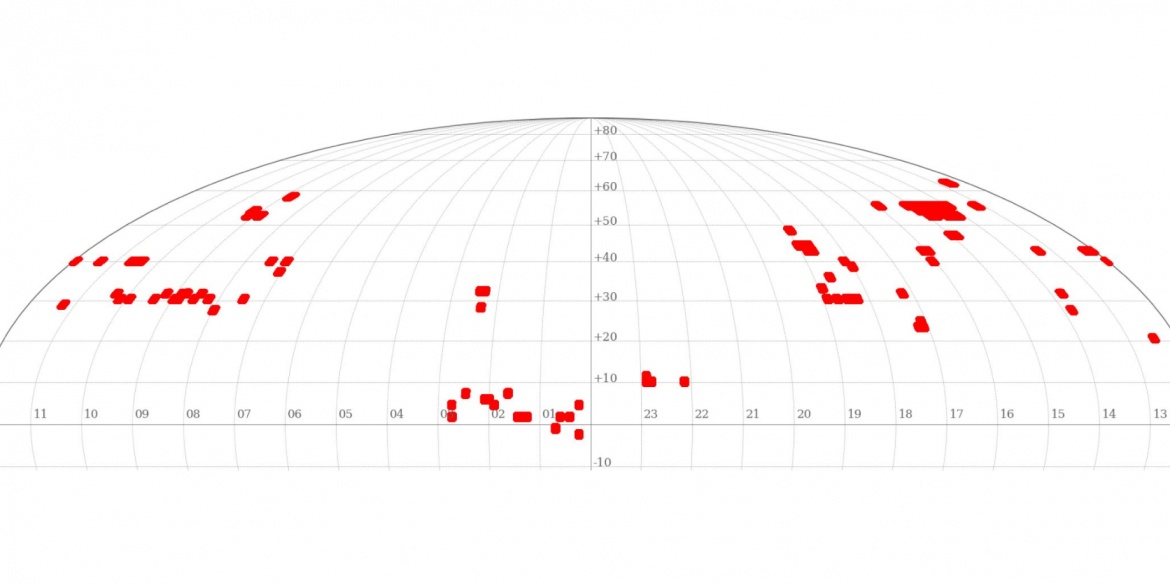
Sky coverage of the 101 fields of J-VAR DR1 shown in equatorial coordinates.
Studying how an astronomical object changes over time often reveals far more about its nature than a single snapshot observation. Many astrophysical sources are inherently variable, including stars that brighten and fade, eclipsing binary systems, supernova explosions, transient phenomena and moving minor bodies in the Solar System. Detecting and characterising these objects requires repeated observations over months or even years.
To address this challenge, the Javalambre Astrophysical Observatory (OAJ) developed the Javalambre VARiability Survey (J-VAR), which now makes available a catalogue containing 1.3 million light curves.
While the J-PLUS survey provides a static view of the sky, J-VAR is designed to quantify how astronomical sources evolve over time. Its first data release covers approximately 200 square degrees and is based on observations obtained with the OAJ's JAST80 telescope using seven optical filters. The survey combines two complementary observing modes: a multi-epoch strategy and a high-cadence programme. Each sky region is observed on eleven different nights, while selected fields are monitored continuously for about three hours to capture rapid variability.
A light curve describes how the brightness of an object changes with time and is therefore a fundamental tool for identifying and characterising variable phenomena such as pulsating stars. The newly released dataset includes 1.29 million stars (96% of all sources), more than 15,000 quasars and approximately 33,000 unresolved sources. It also contains observations of around 1,600 variable stars listed in the international VSX catalogue and more than 3,000 variables identified by the Gaia mission.
One of the main challenges of the project was removing artificial brightness fluctuations introduced by changing observing conditions. Since the data were acquired over multiple observing runs and under different atmospheric conditions, the team implemented a differential calibration approach. Each source was compared with a set of nearby stars assumed to be photometrically stable. If all objects exhibited the same variation pattern, the changes were attributed to atmospheric or instrumental effects rather than intrinsic variability. The catalogue also provides a series of automatically computed variability indices, statistical parameters that help identify and classify variable sources.
The catalogue is described in a scientific paper published in Astronomy & Astrophysics. This dataset will support future studies of variable stars, binary systems, transient sources and minor bodies in the Solar System. The authors report that scientific exploitation of the catalogue is already producing new results, including the discovery of previously unknown variable objects and detailed analyses of known variable stars.
As part of its strategy to facilitate access to enhanced J-PLUS and J-PAS data products, the OAJ is developing, validating and publishing High Added Value Catalogues (CAVA), which provide physical properties for astronomical sources observed by the ICTS Javalambre Astrophysical Observatory. The present work has been carried out within the framework of the J-CAVA project, funded by the European Union – NextGenerationEU under Spain's Recovery, Transformation and Resilience Plan.
This research has also received funding from the Aragón Research Group E16_23 and from project PID2021-124918NB-C42, funded by the Spanish Ministry of Science, Innovation and Universities and the State Research Agency (MCIN/AEI/10.13039/501100011033/FEDER, EU).