

JST250 launches its first Legacy Survey Call, inviting the international scientific community to shape its scientific legacy
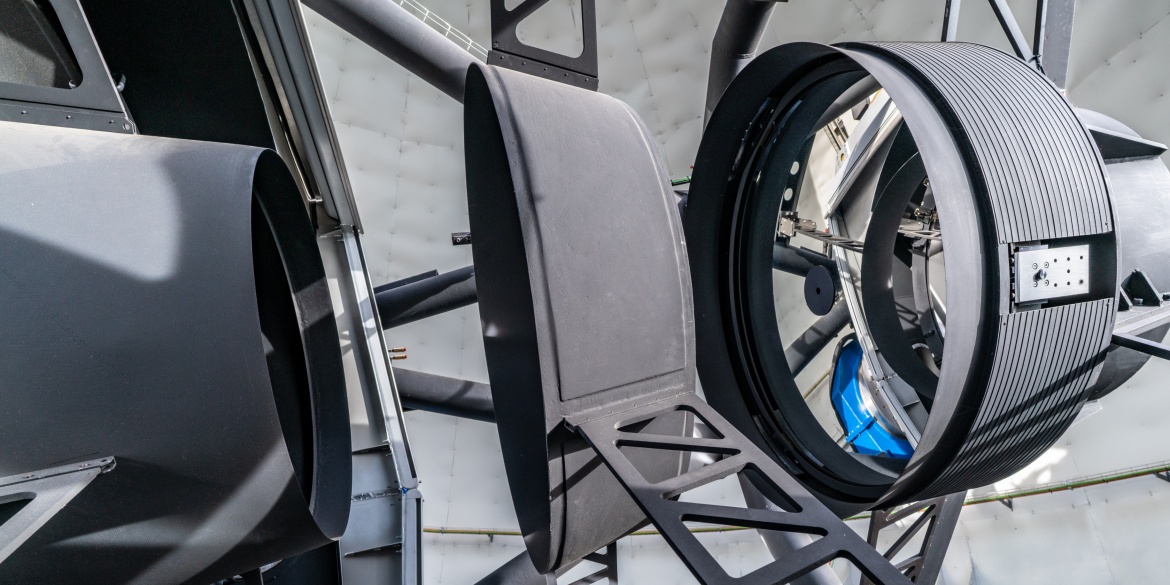
Imagen del espejo primario del JST250
The combination of its 2.55-metre primary mirror, wide field of view and the exceptional quality of the skies over Javalambre is what the JST250 offers to the international scientific community. The Javalambre Astrophysical Observatory is making its most powerful facility available to scientific teams from around the world. Specifically, the call offers 1,200 observing hours distributed over five years, with a submission deadline of 15 September. For the first time, the international scientific community will be able to design research programmes conceived specifically to make full use of the JST250's capabilities over a five-year period.
The call seeks so-called legacy projects, that is, large-scale scientific programmes that will generate high-value datasets. Unlike last year's call, which offered 200 observing hours, this programme will make it possible to undertake projects addressing much broader scientific questions. The aim is to carry out large astronomical surveys, produce catalogues, and tackle scientific topics such as transient phenomena and galaxy evolution. Projects that, like Gaia and CEFCA's own J-PAS and J-PLUS surveys, become reference datasets for the scientific community.
There are already 15 preliminary proposals submitted through Letters of Interest, whose principal investigators took part in June in the preparatory process for the Open Time call, the observing time made available to external researchers. These proposals are led by research institutes and universities from Spain, Brazil, China and the United States. The process began with a conference organised by CEFCA and the Spanish Network of Astronomical Infrastructures (RIA).
The first call for a unique facility
It should be recalled that the JST250 is the only telescope in the world equipped with 56 filters capable of capturing light over very narrow wavelength ranges. This unique capability enables astronomers to observe distant objects and estimate their distances with high precision. It is a wide-field telescope whose performance is supported by one of the world's largest astronomical digital cameras: JPCam, with 1.2 billion pixels.
Originally designed to carry out one of the largest three-dimensional surveys of the sky—the J-PAS project, led by CEFCA—the Javalambre flagship telescope is now entering a new phase that will allow it to realise its full scientific potential. Following a one-year Open Time programme that served as a pilot phase, this new Open Time call will enable more ambitious scientific programmes while fostering collaborations with new research institutes and universities.
Proposals may be submitted until 15 September and will be evaluated by the Time Allocation Committee (TAC). This independent external scientific committee will assess proposals according to criteria including scientific quality, scientific impact, realism and technical feasibility. Full details of the call are available on the call webpage.
The JST250 was formally accepted in February 2016. This technical milestone involved a comprehensive verification process, including technical tests and a fine optical alignment that verified image quality across the telescope's entire field of view. This was followed by the installation of the Pathfinder commissioning camera and, subsequently, JPCam. This call marks the beginning of a new stage in the telescope's scientific operation and further strengthens the role of the Javalambre Astrophysical Observatory as one of Spain's 29 Unique Scientific and Technical Infrastructures (ICTS) recognised by the Ministry of Science, Innovation and Universities.