

Total solar eclipse puts the Javalambre Astrophysical Observatory in the spotlight
Total solar eclipse puts the Javalambre Astrophysical Observatory in the spotlight
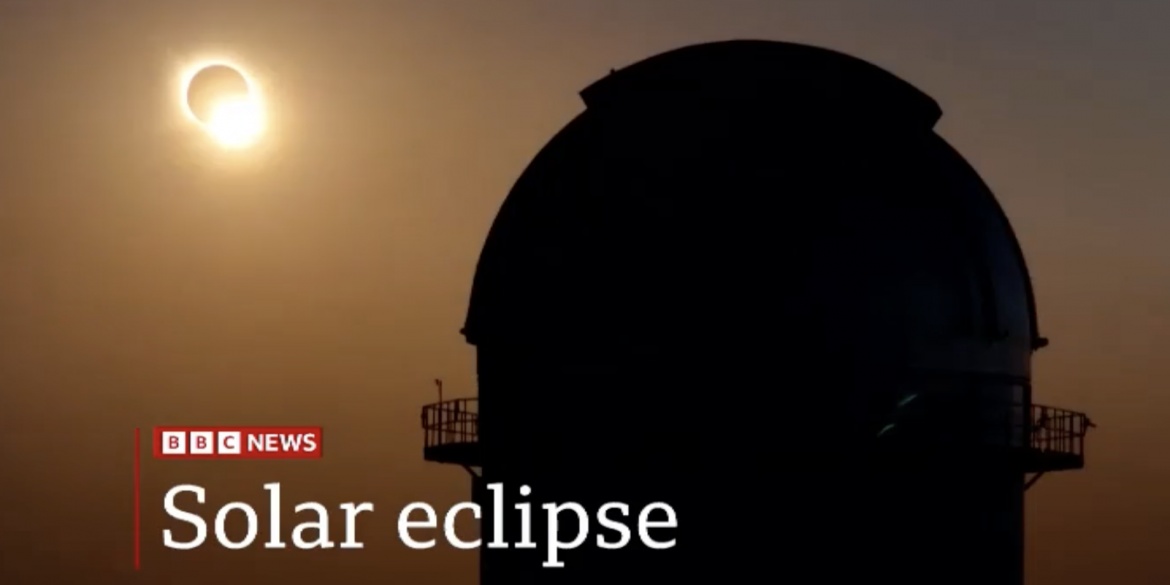
For a few hours on 12 August, the total solar eclipse made the front pages of The New York Times, la Repubblica and El País, and led coverage on CNN, TVE and hundreds of media outlets around the world. This time, however, the Javalambre Astrophysical Observatory was also in the spotlight: thousands of the images that led television news broadcasts and appeared in newspapers were captured there, and it was from the Observatory that the European Space Agency shared this astronomical spectacle with the world.
From Sunday, 9 August, the Javalambre Astrophysical Observatory became a base for international scientific teams and experimental work. A team of researchers from the Istituto Nazionale di Astrofisica began setting up their circular-slit spectrometer, a prototype designed to collect information from the entire ring of the solar corona simultaneously. This reduces a process that would normally take hours to just a few minutes, making it suitable for the brief duration of a total eclipse. Put simply, the aim is to capture the entire solar corona in a single image.
The European Space Agency also sent its team to Teruel several days in advance. In this case, the Javalambre Astrophysical Observatory served as the base for the official worldwide broadcast of the eclipse. A studio was set up beside Javalambre's most powerful telescope, the JST250, from where science communicator Maggie Aderin-Pocock and ESA Director of Science Carole Mundell guided audiences through the eclipse. The OAJ also served as the coordination hub for feeds arriving from across Spain, which together formed part of a special broadcast reaching more than 1.4 million subscribers.
Another striking figure is the 550 television channels that carried footage from Reuters' live broadcast from the OAJ. la Repubblica in Italy, El País in Spain and CNN were among the major media outlets to show the silhouette of the Observatory alongside the solar corona. Reuters was one of 20 media organisations to have journalists accredited at the OAJ. TVE, Telecinco, El País, RNE, Aragón TV and Aragón Radio were among a list that included Spain's leading media organisations as well as some of the world's most prominent outlets. All of them reported on the total solar eclipse from Javalambre.
In total, around 300 people observed the solar corona from Pico del Buitre. Guests representing the institutional and scientific communities included the President of the Government of Aragon, Jorge Azcón; the Director General for Science, Pilar Gayán; and Nobel Prize-winning physicist Alain Aspect. The cultural world was also represented, with guests including Spanish musician Ramoncín and Queen guitarist Brian May.
For several hours, the OAJ itself was transformed, with a marquee, portable toilets and additional safety infrastructure installed for the occasion. For months, technicians and engineers had worked to ensure that every aspect of the event was in place, from mobile phone coverage and communications to facilities and dedicated spaces — including the conversion of the loading bay into a press room. The eclipse required a major human and technical effort, but it also demonstrated the capacity of the OAJ and the team behind it to host scientific experiments and outreach activities while accommodating intense international media attention.
The organisation of the event was supported by the Teruel Provincial Council and the Government of Aragon.