

CEFCA’s Surveys stand out at the closing event of the Complementary Plan in Astrophysics
CEFCA’s Surveys stand out at the closing event of the Complementary Plan in Astrophysics
Three years after its launch, Andalusia, Cantabria, Catalonia, the Community of Madrid, the Valencian Community, the Balearic Islands and Aragón, together with the Ministry of Science, Innovation and Universities (MICIU), presented the key achievements of the Complementary Plan in Astrophysics and High-Energy Physics. The meeting, held this week in Santander, marks the official conclusion of the project.
During the event, CEFCA—responsible for coordinating the Plan in Aragón—announced the fourth data release of the J-PLUS survey, one of the latest milestones achieved. This survey, carried out with the JAST80 telescope and its 12 photometric bands, produces an unprecedented three-dimensional map that has now characterised 100 million astronomical objects in the nearby Universe. It is designed to provide essential information on Milky Way stars, nearby galaxies, and objects located at specific distances measurable thanks to its tailored filter system. The survey has now reached 4,950 of the 8,500 square degrees planned—covering one-fifth of the entire sky.
Among the major contributions led by CEFCA is JPCam, one of the largest astronomical cameras in the world. Its 1,200 million pixels capture nightly observations with the JST250 telescope, the largest instrument at the Javalambre Astrophysical Observatory. The commissioning and optimisation of JPCam stands as one of the flagship achievements of the Complementary Plan. The camera plays a central role in the J-PAS survey, which released its first data to the scientific community one year ago and represents another of the major scientific projects enabled by the Plan. J-PAS has supported the hiring of 11 postdoctoral and 4 predoctoral researchers—both in Aragón and in other participating regions—who have contributed to the scientific exploitation of the data.
Javier Cenarro, CEFCA Director, and Carlos López San Juan, Head of Research, reviewed both the progress of the large surveys and the specific contributions made by the CEFCA-led projects J-PAS, J-PLUS and J-VAR.
“The Complementary Plan has made it possible to fund technical and scientific advances that have accelerated the commissioning and data analysis of J-PAS and strengthened synergies and collaborations: nationally, with groups working on similar projects, and within the region, with teams developing other areas of Physics. In both cases, it opens the door to future joint efforts.”
The meeting, held at the Palacio de la Magdalena, brought together 10 astronomical institutions—including the Andalusian Institute of Astrophysics (IAA-CSIC) and the Institute of Cosmos Sciences at the University of Barcelona (ICCUB). Thirteen universities also participated in the closing sessions. From Aragón, the two institutions represented were CEFCA and the Center for Astroparticles and High-Energy Physics at the University of Zaragoza.
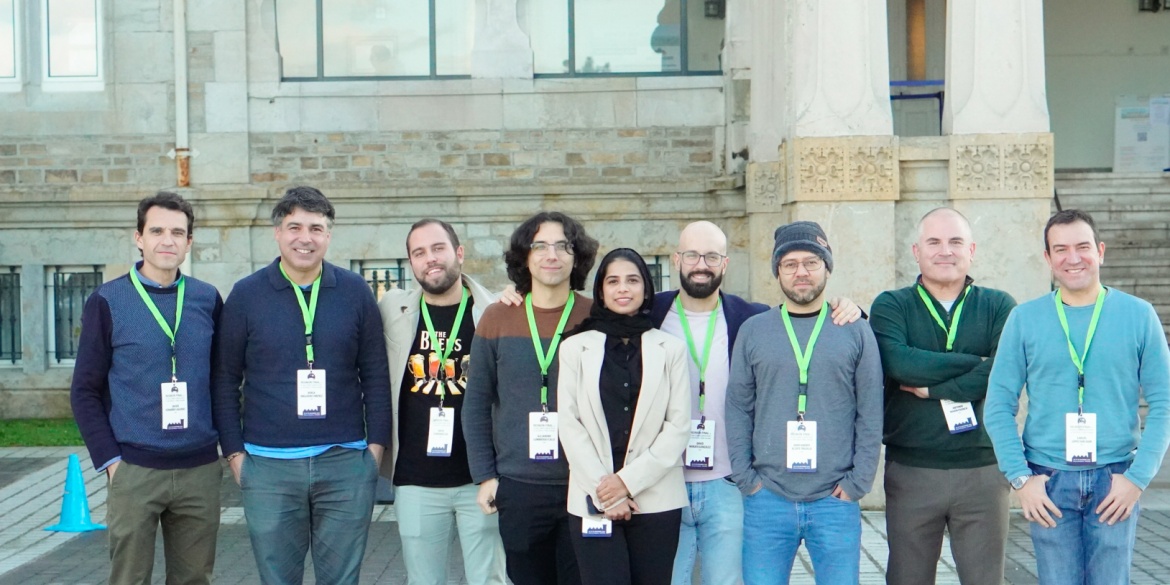
Representing CEFCA were its Director, Javier Cenarro; the Head of Research, Carlos López San Juan; the Head of the Javalambre Astrophysical Observatory, Antonio Marín; and researchers Jairo Andrés Alzate Trujillo, Borja Anguiano, David Fernández Gil, Alejandro Lumbreras Calle, David Morate and Rahna Payyasseri Thanduparackal, who delivered nine presentations on the main results of their research. CEFCA scientists had already contributed six talks to the meeting held in Aragón in October at the Aragón Institute of Technology, which marked the regional conclusion of the Plan.
Figures of the Complementary Plan
The Plan has mobilised €39 million—€22.8 million from MICIU and the remainder contributed by the regional governments. According to ministry data, it has enabled the hiring of 284 professionals, generated six patents, consolidated more than 44 industry collaborations and led to the creation of a spin-off company.
Major advances achieved under the Plan also include the development of tuneable spectropolarimeters (TIS/TIF) for the European Solar Telescope. In the field of Neutrino Physics, a new cryogenics laboratory has been established to optimise large-area photonic devices and explore new concepts for photosensitive pixels. A unique laboratory dedicated to the characterisation of quantum sensors has also been built. Notable progress has been made on the PhotSat mission, strengthening the local space industry and advancing the development of a 3U CubeSat-class satellite. Additionally, the CosmoHub initiative has expanded its team, modernised its computational infrastructure and developed new software to enhance its capacity for managing large astrophysical datasets.
Eight Complementary Plans
The Government of Spain approved the first four Complementary Plans in 2021, dedicated to renewable energy and hydrogen, marine sciences, quantum communication and biotechnology applied to health. In 2022, four additional Plans were launched in Agro-food, Astrophysics and High-Energy Physics, Advanced Materials and Biodiversity.
Together, the eight Complementary Plans have mobilised €466 million—€299.2 million funded by MICIU (64.2% of the total budget) and €166.9 million (35.8%) contributed by the regional governments.
These initiatives have fostered collaboration and aligned the efforts of the national administration, regional governments and European funds to address key strategic challenges for Spain, in accordance with the EU’s guidelines for transformative measures under the Recovery Plan.