

The Javalambre Astrophysical Observatory sets its sights on the dwarf planet Haumea, the Andromeda Galaxy, and the Hercules Cluster
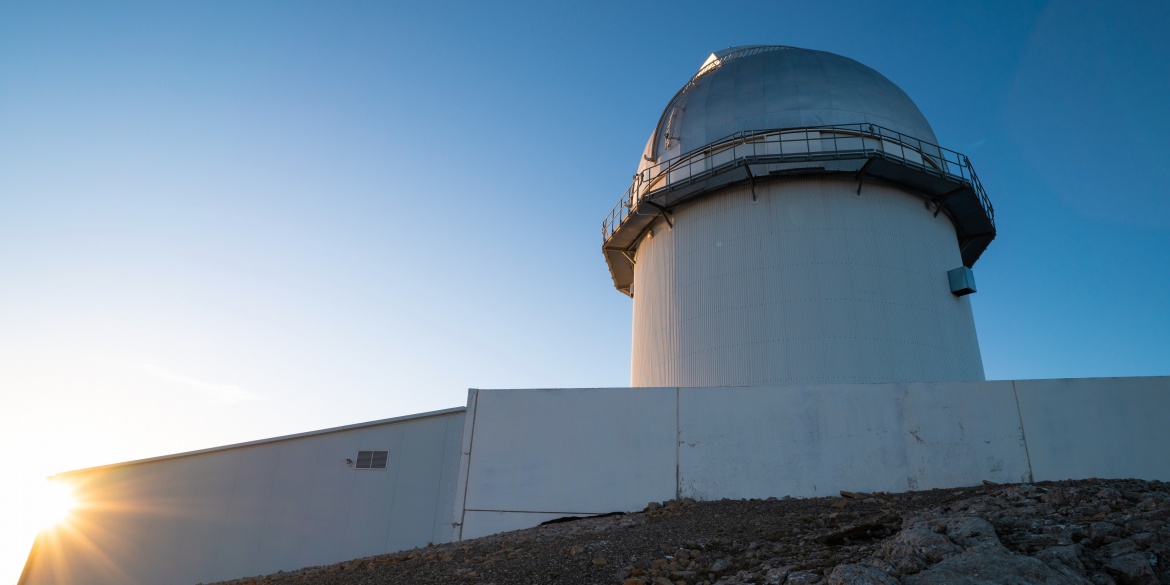
The Javalambre Astrophysical Observatory sets its sights on the dwarf planet Haumea, the Andromeda Galaxy, and the Hercules Cluster
Six projects were selected by the Time Allocation Committee one year ago from a total of ten proposals submitted. Among them are highly targeted studies, such as the observation of the dwarf planet Haumea beyond Neptune during a stellar occultation in May. Other programmes, such as J-ARRAS and AURORA, will conduct broader searches aimed at detecting variable stars and asteroids. Additional research projects will take advantage of the wide field of view of the main telescope at the Javalambre Astrophysical Observatory (OAJ) and its 56 filters—unique worldwide—to study specific galaxies in detail and shed light on the formation and evolution of galaxies.
These projects open the OAJ to new research avenues, combining the technical expertise of the CEFCA team with the scientific knowledge of research groups involved in projects different from those already being carried out in Teruel. The JST250 telescope was designed to conduct one of the largest three-dimensional surveys of the sky (J-PAS), but its flexibility in targeting specific objects allows studies ranging from the Solar System to the distant Universe.
Tracking the asteroids that formed our Solar System
One of the highlighted projects is J-ARRAS, which will focus on the detection of asteroids. These objects are remnants from the formation of the Solar System, which is the main observational focus of this project.
The novelty lies in the use of the unique filter system developed for the J-PAS survey, which will allow astronomers to study a specific portion of the light emitted by these objects: the near-ultraviolet range. Observing this spectral region in unprecedented detail will make it possible to determine the composition of these asteroids and, in particular, search for the possible presence of complex organic compounds—the fundamental building blocks of life on our planet.
Andromeda in detail
J-ATLAS is another key project defining where the JST250 will be looking this year. In this case, it will monitor the nearest massive galaxy to the Milky Way: the Andromeda Galaxy (M31).
The goal is to exploit the wide field of view of the JST250 to study the outermost regions of the galaxy—its stellar halo. Observing these areas in detail will allow astronomers to determine the composition and formation history of the stars that populate this halo.
Investigating the outer Solar System: Haumea
If current predictions hold, on 4 May the dwarf planet Haumea will occult a background star. Haumea is one of the five known dwarf planets and one of four located in the outer reaches of the Solar System.
A previous occultation in 2017 led to the discovery of the ring surrounding Haumea through an international campaign involving ten observatories. This time, Javalambre will be one of the best observing sites worldwide to monitor the new event, with the challenge of determining whether Haumea possesses an atmosphere.
Haumea lies beyond Neptune’s orbit in a region populated by icy and rocky bodies known as the Kuiper Belt, where four dwarf planets stand out: Pluto, Eris, Makemake, and Haumea.
Understanding how galaxies formation
Javalambre will also contribute data to improve our understanding of galaxy formation, specifically through observations of the Sextans dwarf spheroidal galaxy.
Dwarf galaxies are the most abundant galaxies in the Universe, yet their low brightness makes them among the least well understood. Understanding them is key to deciphering galactic evolution. In the standard cosmological model, these galaxies act as the building blocks from which larger systems assemble.
Measuring the abundances of different chemical elements in this dwarf galaxy could reveal whether dwarf galaxies themselves also accrete and disrupt even smaller systems. These observations will also allow astronomers to search for very low-mass dark galaxy candidates—systems expected to exist around dwarf galaxies like Sextans but that contain neither stars nor gas, making them extremely difficult to detect.
Capturing variable phenomena and the Hercules Cluster
AURORA is another key project at the OAJ in 2026. It focuses on the search for variable phenomena such as supernovae or stars whose brightness changes over time.
Periodic variable stars serve as important distance indicators. This programme will make use of telescope time that is usually discarded by other projects because of less-than-ideal observing conditions, such as bright skies, clouds, or poor seeing.
Finally, the J-PAS filters will be used to survey the Hercules galaxy cluster. As one of the nearest galaxy clusters, it can be studied in great detail. Observations from Javalambre, together with the capabilities of the JST250 and JPCam, will allow the entire cluster to be covered in a single programme. This will enable the most detailed study to date of the galaxies that compose the cluster and provide insight into the formation history of one of the largest structures in the Universe.
All these projects were selected in the first Open Time call of the JST250, one of the commitments made to the international scientific community as part of its role as a Singular Scientific and Technical Infrastructure (ICTS).
Due to the specific characteristics of JPCam, the CEFCA team has developed a dedicated observing tool to execute these projects. Researchers define the target area and observing requirements, while OAJ telescope operators configure what is known as the observing strategy.