

Schoolchildren in Teruel get ahead of the Eclipse
Schoolchildren in Teruel get ahead of the Eclipse
They are the first to put on eclipse glasses. They do so just before becoming researchers themselves, counting the Sun’s sunspots that morning in order to understand the questions our star still raises and the scientific work that will be carried out during the eclipse. This is one of the experiences bringing the Sun closer to students from all participating schools in these workshops developed by the Centro de Estudios de Física del Cosmos de Aragón (CEFCA).
Around 1,500 students, aged between 6 and 12 and ranging from first to sixth grade of primary education, will take part in the workshops “Más cerca del Sol”. This activity covers a wide age range and is adapted to each level, adjusting both the depth of explanations and the content. Students also have access to a solar telescope and binoculars, and learn how to build a simple solar projector to observe the Sun.
By the end of this second phase, aimed at students in the city of Teruel, nearly 2,300 children across the province will have taken part in the workshop. They will have discovered the science behind an eclipse, understood how it works, accessed real images and videos of the phenomenon, and received essential information on safe eclipse observation.
It is worth noting that the entire province is a privileged location for observing the total solar eclipse on 12 August 2026. Northern Spain will experience a total eclipse for the first time in a century and will be one of the best places in the world to observe it. Indeed, accommodation searches in towns along the path of totality have already increased tenfold (according to data from a booking platform), and Teruel is expected to receive thousands of visitors.
“Más cerca del Sol” toured 10 schools across the province during the first term, reaching all regions to explain—almost as a game—what this phenomenon is and allowing children to discover it together with their classmates. In this second phase, seven schools from the city of Teruel are joining the programme. The first phase was carried out with the support of the Instituto de Estudios Turolenses and was selected as one of eight Cultural and Scientific Outreach projects.
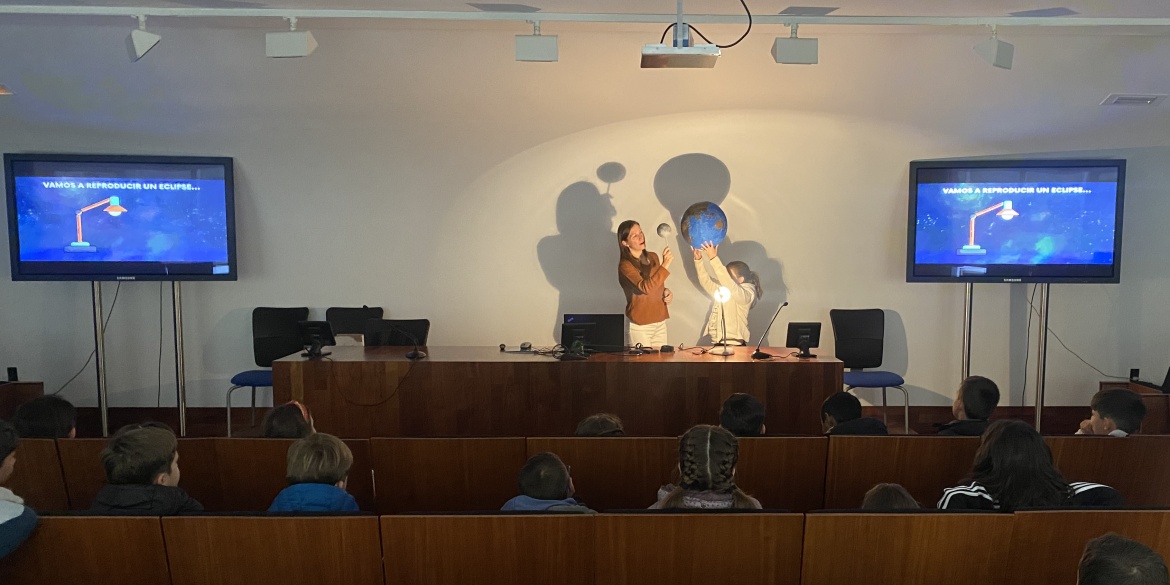
A simple hand game helps introduce cosmic distances, a desk lamp becomes the Sun, and students create a Moon out of modelling clay. These are just three examples of the combination of hands-on activities and play that simplify the concepts behind an eclipse. The aim is to understand cosmic coincidence, motion and light, and the phases of the Moon. The materials, activities, and content have been developed by CEFCA’s UCC+I in collaboration with teachers.
The activity is supported by audiovisual materials as well as two specific resources: a teaching guide and explanatory panels. The guide, designed specifically for this programme, covers topics ranging from the types of eclipses that will occur over the next three years to the phenomena to observe during the minute and a half when the Sun will be obscured next summer. In addition, panels featuring real images of the Sun explain its characteristics, layers, and phenomena such as auroras.
Through the children, CEFCA also aims to prepare families by sharing key information about the eclipse. The goal is to ensure that this audience is equipped not only to understand but also to fully experience an event that will leave a lasting impression and represents an opportunity to bring science and its everyday relevance closer to the public. This activity is part of a broader programme of talks, workshops, and initiatives being organised in preparation for this event.