

J-PAS releases data on 1.3 million objects
J-PAS releases data on 1.3 million objects
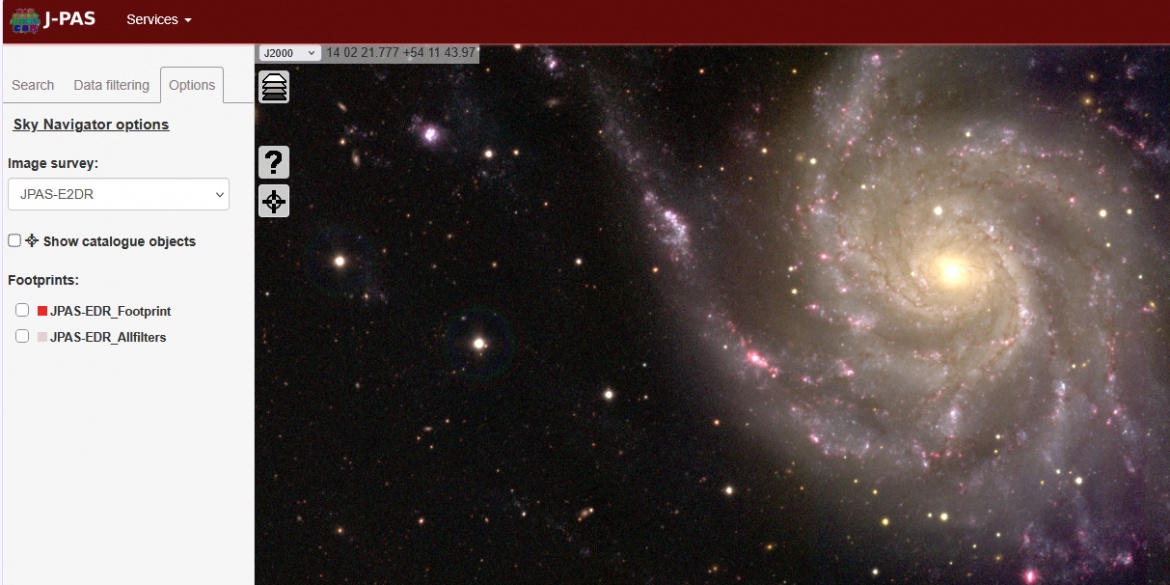
J-PAS, led by the Centro de Estudios de Física del Cosmos de Aragón (CEFCA) and the Instituto de Astrofísica de Andalucía (IAA-CSIC) in Spain, is making the first 28 square degrees of its three-dimensional map of the Universe available to the scientific community. The survey is being conducted from the Observatorio Astrofísico de Javalambre, and its images and catalogues are available through its website (https://archive.cefca.es/catalogues/jpas-edr/).
The region of sky now publicly available contains 1.3 million astronomical objects and represents just a small sample of the survey data. J-PAS will observe thousands of square degrees over the next 10 years. The data release is the main scientific highlight of the “Understanding the Universe Large Surveys Meeting”, which has brought together researchers from 15 countries in Teruel over five days, representing 20 of the world’s leading projects mapping the Universe on large scales: “There has always been tremendous interest in J-PAS and its data. What is new is that the survey is now beginning to provide substantial sky coverage and a statistically significant sample. This will raise its profile, and the conference is also helping to achieve that. The meeting has given researchers from major international projects and surveys a first-hand introduction to J-PAS, so they can now factor it into their research and use its data to pursue their scientific goals,” explains Héctor Vázquez-Ramió, head of the Data Processing and Archiving Unit (UPAD).
Understanding the Universe from Javalambre
This Extended Early Data Release (E2DR) builds on the initial data release of November 2024. It expands the available data and makes them accessible to the entire research community, beyond the J-PAS collaboration. As of today, the international J-PAS project provides data covering a total of 380 square degrees, of which 28 square degrees have been fully observed with all 57 survey filters.
The Javalambre Physics of the Accelerating Universe Astrophysical Survey (J-PAS) combines two unique capabilities: observing a large volume of the Universe in an unprecedented number of photometric bands. The wide-field JPCam camera incorporates 56 optical narrow-band filters designed specifically for the project, a system unmatched anywhere in the world. In practice, this provides uniform spectral information for all observed objects, allowing researchers to derive astrophysical properties such as stellar temperatures and chemical compositions, or galaxy ages and distances, among many others.
Millions of images and thousands of celestial objects
J-PAS is releasing data for 28 square degrees of sky observed with its 56 filters. The survey now includes 570,000 galaxies, along with 250,000 objects classified as stars and 8,500 quasar candidates. The faintest objects have yet to be classified and account for the remainder of the total.
This E2DR offers a preview of the first full data release, due at the end of 2026. By the end of the year, J-PAS will have observed 155 square degrees with its full set of filters. It will also have covered around 500 square degrees with at least 10 of its filters. When the survey is completed in ten years, it will have observed thousands of square degrees of sky, containing hundreds of millions of galaxies and stars. A distinctive feature of J-PAS is that its images provide information for every pixel across the observed sky. The images themselves are calibrated, allowing the intensity of the light to be measured at any point within the survey area in each of its 56 filters.
J-PAS was the scientific driver behind the design and construction of the OAJ, which has been part of the Spanish Ministry of Science, Innovation and Universities’ network of Unique Scientific and Technical Infrastructures (ICTS) since 2014. J-PAS is a key component of the project “Advanced technologies for exploring the Universe and its components”, funded by the European Union (NextGenerationEU) under the Complementary Plans programme with Spain’s autonomous communities, in the area of Astrophysics and High Energy Physics.
The OAJ and J-PAS are also funded by CEFCA and the governments of Aragón and Spain through the Teruel Investment Fund and the European Regional Development Fund. The Brazilian funding agencies FINEP, FAPESP and FAPERJ, together with Brazil’s National Observatory, have contributed to the funding of JPCam. Estonia’s Tartu Observatory and the Chinese J-PAS Astronomical Consortium have provided additional funding for J-PAS.