

Three opportunities: a trio of eclipses
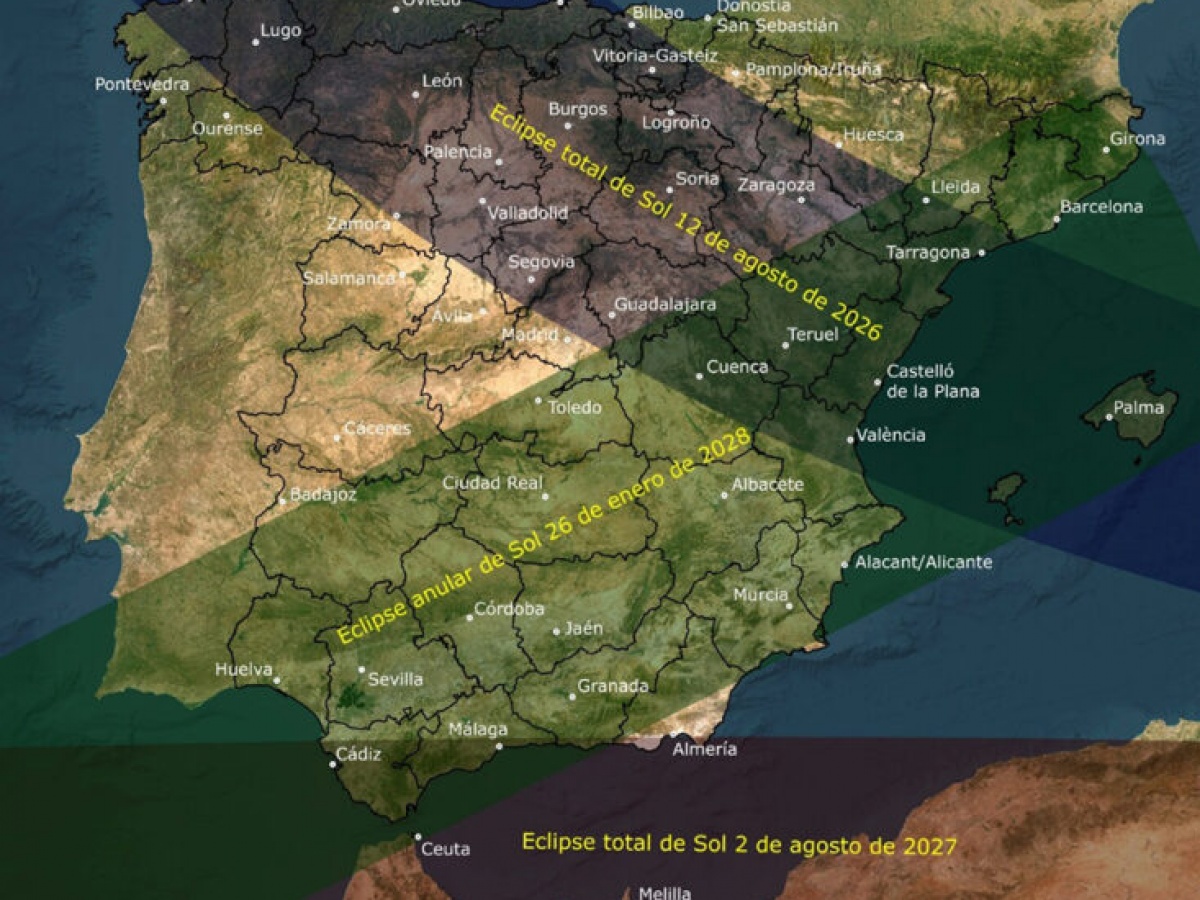
Totality (2026 and 2027) and annularity (2028) paths of the solar eclipses that will be visible on the Iberian Peninsula in the coming years. CREDIT: Instituto Geográfico Nacional (IGN)
Despite the unpredictability of the weather, Spain will have three opportunities to experience and better understand these phenomena. Between 2026 and 2028 there will be two total solar eclipses and one annular eclipse visible from parts of the country.
The first event, expected on 12 August 2026, will cross Spain from west to east. Its path will pass over numerous provincial capitals, from A Coruña to Palma de Mallorca, including Zaragoza and Teruel in Aragón.
Almost a year later, on 2 August 2027, another total solar eclipse will cross Spain. In this case, the path of totality will run from west to east across the Strait of Gibraltar, covering the southern tip of the Iberian Peninsula and northern Africa. Some of the most privileged viewing locations will include Cádiz, Málaga, Algeciras, Ceuta and Melilla. The eclipse will occur in the morning, and the longest duration of totality will be visible from Ceuta, where it will last nearly five minutes.
The final date to mark in the calendar is 26 January 2028, when an annular eclipse will take place. Its path of annularity will cross the Peninsula from southwest to northeast just before sunset. The band will include cities such as Seville, Granada, Murcia and Valencia. Teruel and Castellón will be the only two provinces from which both the total eclipse of 2026 and the annular eclipse of 2028 can be fully observed.
Eclipses are an opportunity to spark new vocations, to feel connected with science and with the cosmos, and simply to share a unique experience offered by nature.