

The first total eclipse in a century
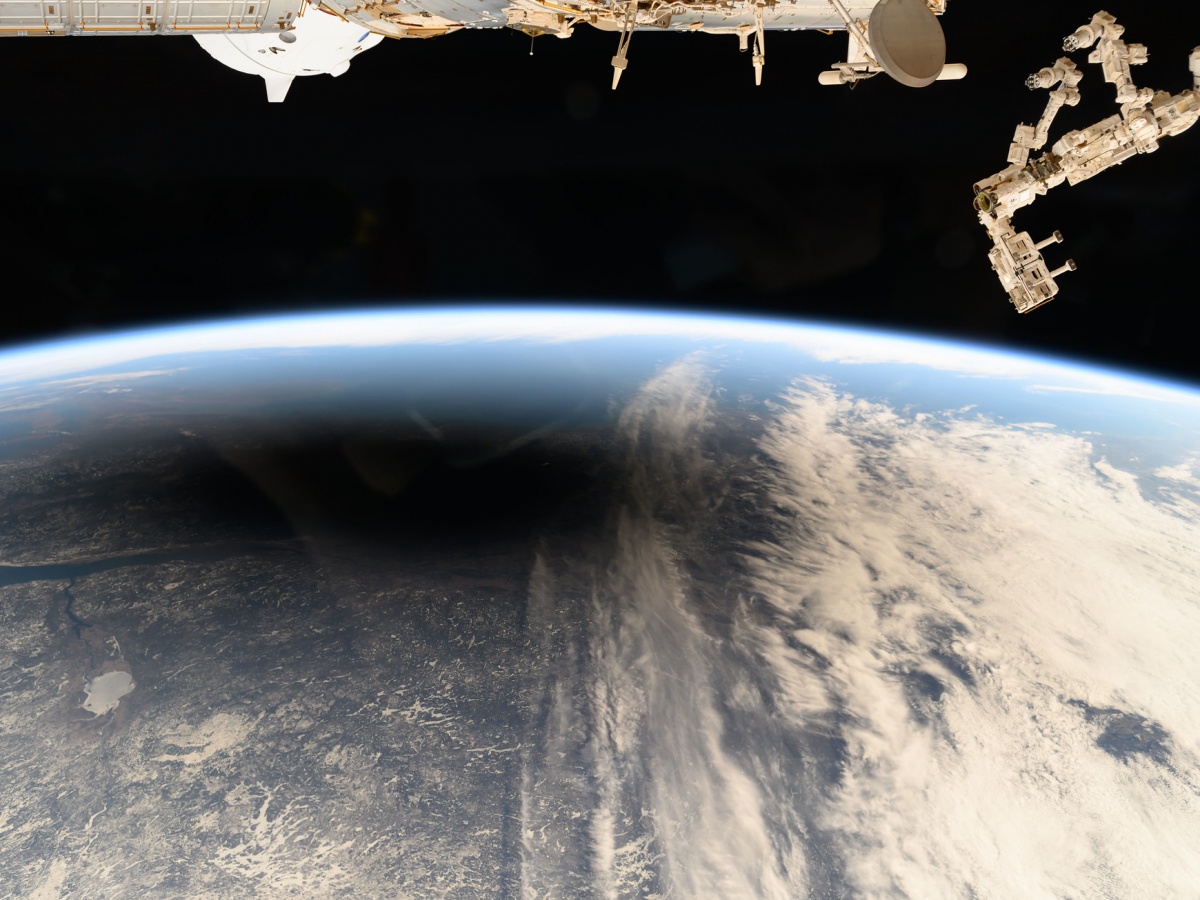
The moon’s shadow on the Earth’s surface during a solar eclipse. NASA
“The heart and the Sun have their systems
and also eclipses and dark shadows.”
Mario Benedetti’s poem “Eclipses” is a vivid reminder of the evocative power of this astronomical phenomenon.
A solar eclipse—especially a total one—takes us back to the very origins of science: the human impulse to understand what surrounds us. A brief and sudden night in the middle of the day helps explain why, for centuries, myths grew around this event. The Sun and the Moon were turned into deities, and legends imagined stories ranging from love to rivalry between these two celestial bodies, transformed into characters of fable.
An eclipse also brings us back, for a moment, to the classroom, reminding us how we first learned to look at our place in the Universe. The motions of rotation and revolution, and the dynamics of the Sun–Earth–Moon system that often introduce us to astronomy. At the same time, eclipses expose us to the very phenomena that scientists use today to study the outermost layers of the Sun or the surface features of the Moon—and that once helped confirm a theory that once seemed purely abstract: Einstein’s theory of relativity.
Accounts from past observations tell us that this sudden darkness briefly transforms everything around us: the temperature drops, the wind shifts, animals change their behaviour. We rely on those historical reports because it has been more than a century since a total solar eclipse was visible from mainland Spain. The last one, in 1912, lasted barely seven seconds. That fleeting duration captures the rarity and uniqueness of a total eclipse—an event that, for many people, may happen only once in a lifetime.
Eclipses have been explored through art and science alike, and they have always become remarkable occasions. They are opportunities for which we should be prepared, both as a society and as a country. On a personal level, each of us should choose where we will watch it and be ready to observe it safely.