

¿What is a solar eclipse?
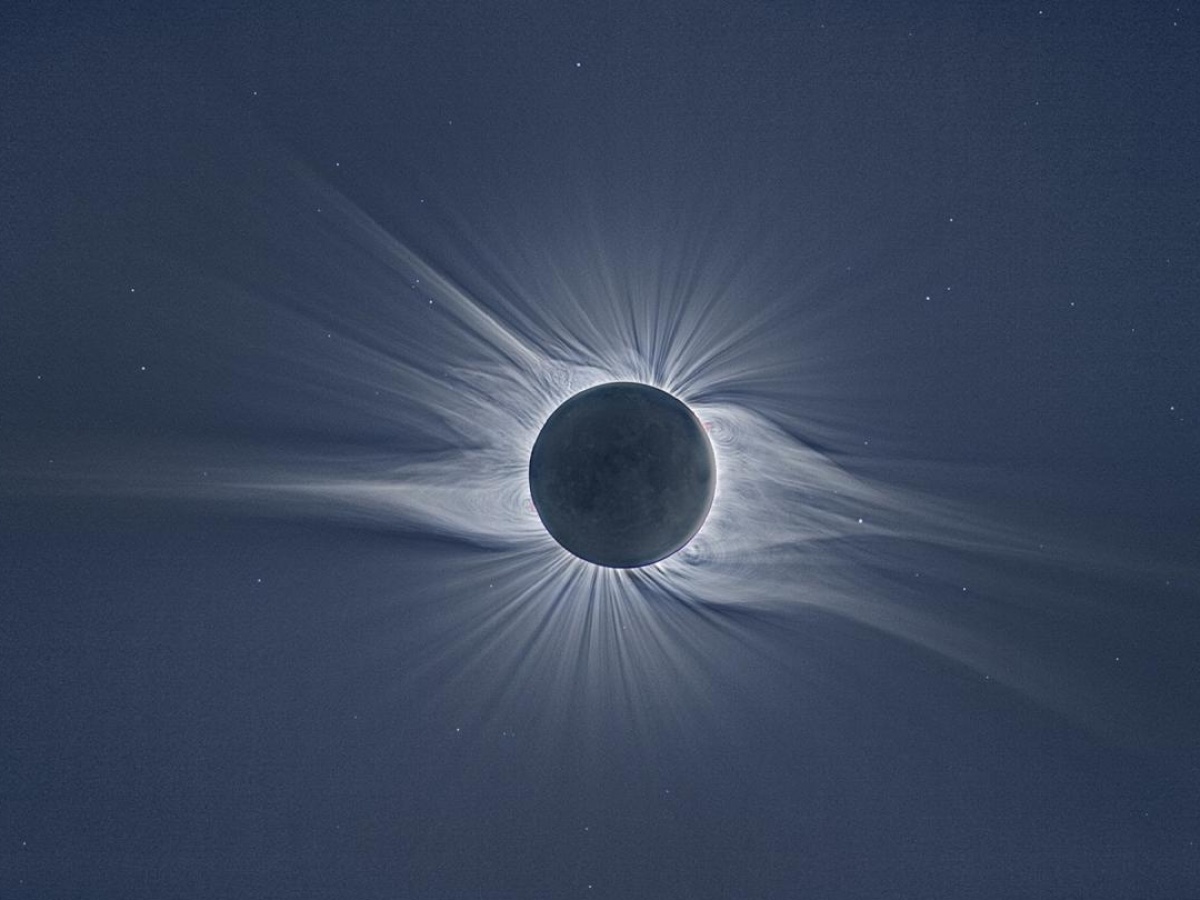
Total solar eclipse. Crédits: J.C Casado y D. López - starryearth.com. Shelios 2008
In the simplest terms, an eclipse happens when one celestial body blocks the Sun’s light from the observer. Seen from Earth, it is the Moon that hides our star. For those observing from the ground, eclipses can be of three types: total, annular, and partial. What distinguishes them is how much of the Sun’s surface is covered by the Moon.
When the Moon completely covers the solar disk, the observer experiences a total eclipse. If the Moon shifts slightly in any direction, the Sun would no longer be fully covered and the event becomes a partial eclipse. There are also occasions when, because of the distances between the Sun, Earth, and Moon, the Moon does not entirely cover the Sun even when their centres are well aligned. In these cases, a bright ring remains visible around the Sun, producing what is known as an annular eclipse.
The last total solar eclipse visible from Spain could only be observed from the Canary Islands in 1959. From the Iberian Peninsula itself, none has been seen since 1912. Looking at other recent examples, the last annular eclipse visible from Spain occurred in 2005, while the most recent partial eclipse—far more common—took place in March 2025.
Across the whole of Europe, throughout the 21st century, only 10 total eclipses and 13 annular eclipses will be visible.

Credits: Total eclipse (left): NASA/MSFC/Joseph Matus; Annular eclipse (center): NASA/Bill Dunford; Partial eclipse (right): NASA/Bill Ingalls